AWS ML Engineer Associate (MLA-C01) Practice Questions & Study Guide
# Complete Study Guide for the AWS Certified Machine Learning Engineer - Associate (MLA-C01) Exam
The AWS Certified Machine Learning Engineer - Associate (MLA-C01) is a mid-level certification designed to validate your proficiency in implementing, deploying, and maintaining machine learning (ML) models on the Amazon Web Services (AWS) ecosystem. As ML becomes more integrated into every aspect of software engineering, this certification is increasingly sought after by developers, data scientists, and ML engineers.
## Why Pursue the AWS Machine Learning Engineer Associate Certification?
Earning the MLA-C01 badge demonstrates that you:
- Understand core AWS machine learning services and their common use cases.
- Can design and implement ML architectures that meet specific requirements.
- Understand the ML lifecycle and how to manage and maintain models at scale.
- Can ensure model performance, security, and compliance across the entire ML pipeline.
## Exam Overview
The MLA-C01 exam consists of 65 multiple-choice and multiple-response questions. You are given 130 minutes to complete the exam, and the passing score is 720 out of 1000.
### Key Domains Covered:
1. **Data Preparation for ML (28%):** This is the largest domain. It covers your ability to ingest, transform, and store data for ML using services like Amazon S3, AWS Glue, and Amazon EMR. You'll need to understand data formats and how to handle missing data and outliers.
2. **ML Model Implementation and Development (26%):** This domain focuses on your knowledge of SageMaker’s built-in algorithms and how to train and tune ML models. You must be familiar with SageMaker notebooks, training jobs, and how to use built-in algorithms like XGBoost and K-Means.
3. **ML Model Deployment and Operations (24%):** This section covers the deployment and monitoring of your ML models. You’ll need to be proficient with SageMaker endpoints, model hosting, and how to use AWS CloudWatch for monitoring and logging.
4. **ML Security, Governance, and Compliance (22%):** Security is a top priority in AWS. This domain tests your knowledge of AWS IAM, AWS KMS, and how to implement encryption for data at rest and in transit. You’ll also need to understand how to secure your SageMaker environments.
## Top Resources for MLA-C01 Preparation
Successfully passing the MLA-C01 requires a mix of theoretical knowledge and hands-on experience. Here are some of the best resources:
- **Official AWS Training:** AWS offers specialized digital and classroom training specifically for the Machine Learning Engineer Associate.
- **AWS Whitepapers and Documentation:** Focus on the "AWS Machine Learning Guide" and whitepapers on ML best practices.
- **Hands-on Practice:** There is no substitute for building. Set up SageMaker notebooks, train models, and experiment with different algorithms and hyperparameters.
- **Practice Exams:** High-quality practice questions are essential for understanding the associate-level exam format. Many candidates recommend using resources like [notjustexam.com](https://notjustexam.com) for their realistic and challenging exam simulations.
## Critical Topics to Master
To excel in the MLA-C01, you should focus your studies on these high-impact areas:
- **Amazon SageMaker:** Master the entire SageMaker ecosystem, including notebooks, training jobs, and hosting endpoints.
- **ML Algorithms:** Understand the use cases and nuances of built-in algorithms like XGBoost, K-Means, and Linear Learner.
- **Feature Engineering:** Know how to transform raw data into features that improve model performance using techniques like one-hot encoding and normalization.
- **Model Evaluation and Tuning:** Understand how to interpret confusion matrices and how to use SageMaker Automatic Model Tuning (AMT) to optimize hyperparameters.
- **Security for ML:** Deep dive into IAM roles, encryption for data at rest and in transit, and how to secure SageMaker environments.
## Exam Day Strategy
1. **Pace Yourself:** With 130 minutes for 65 questions, you have about 2 minutes per question. If a question is too difficult, flag it and move on.
2. **Read Carefully:** Pay attention to keywords like "most accurate," "least operational overhead," or "most cost-effective." These often dictate the correct answer among several technically feasible options.
3. **Use the Process of Elimination:** If you aren't sure of the right choice, eliminating obviously incorrect options significantly increases your chances.
## Conclusion
The AWS Certified Machine Learning Engineer - Associate (MLA-C01) is a valuable credential that validates your skills in implementing and maintaining machine learning solutions on the AWS platform. By following a structured study plan, using high-quality practice exams from [notjustexam.com](https://notjustexam.com), and gaining hands-on experience, you can master the complexities of AWS machine learning and join the elite group of certified associate engineers.
Free AWS ML Engineer Associate (MLA-C01) Practice Questions Preview
-
Question 1
Case Study -
A company is building a web-based AI application by using Amazon SageMaker. The application will provide the following capabilities and features: ML experimentation, training, a central model registry, model deployment, and model monitoring.
The application must ensure secure and isolated use of training data during the ML lifecycle. The training data is stored in Amazon S3.
The company needs to use the central model registry to manage different versions of models in the application.
Which action will meet this requirement with the LEAST operational overhead?
- A. Create a separate Amazon Elastic Container Registry (Amazon ECR) repository for each model.
- B. Use Amazon Elastic Container Registry (Amazon ECR) and unique tags for each model version.
- C. Use the SageMaker Model Registry and model groups to catalog the models.
- D. Use the SageMaker Model Registry and unique tags for each model version.
Correct Answer:
C
Explanation:
I agree with the selected answer C. The SageMaker Model Registry with model groups is the purpose-built AWS service for managing ML model versions in a centralized manner with minimal operational overhead. It provides native integration with all SageMaker features mentioned in the requirements (experimentation, training, deployment, monitoring) and automatically handles version numbering within model groups. This is the most appropriate solution for the stated requirements.
Reason
Option C is correct because SageMaker Model Registry is specifically designed for centralized model management and versioning. Model groups in the registry logically organize related models, and each model package added to a group is automatically assigned an incremental version number (1, 2, 3, etc.). The registry provides built-in capabilities for model cataloging, approval workflows, deployment history tracking, and seamless integration with other SageMaker components like training jobs, endpoints, and monitoring. This native AWS service requires the least operational overhead compared to implementing custom solutions with ECR or manual tagging systems. The registry also supports metadata tracking, model lineage, and governance features essential for enterprise ML applications.
Why the other options are not as suitable
- Option A is incorrect because Amazon ECR (Elastic Container Registry) is designed for storing and managing container images, not ML models. Creating separate ECR repositories for each model would introduce significant operational overhead, require custom versioning logic, and does not provide ML-specific features like model approval workflows, lineage tracking, or integration with SageMaker's deployment and monitoring capabilities.
- Option B is incorrect because while Amazon ECR with tags could technically version containers, ECR is not a model registry—it's a container image repository. Using tags for model versioning would require manual management, lacks built-in model governance features, and does not integrate natively with SageMaker's ML lifecycle management tools. This approach would create more operational overhead than using the purpose-built Model Registry.
- Option D is incorrect because while it mentions SageMaker Model Registry (which is correct), the statement about using unique tags for versioning is misleading. The Model Registry automatically manages versions through model groups with numerical versioning (1, 2, 3, etc.), not through custom tags. Model groups are the proper construct for organizing and versioning models, making option C the more accurate and complete answer.
Citations
-
Question 2
Case Study -
A company is building a web-based AI application by using Amazon SageMaker. The application will provide the following capabilities and features: ML experimentation, training, a central model registry, model deployment, and model monitoring.
The application must ensure secure and isolated use of training data during the ML lifecycle. The training data is stored in Amazon S3.
The company is experimenting with consecutive training jobs.
How can the company MINIMIZE infrastructure startup times for these jobs?
- A. Use Managed Spot Training.
- B. Use SageMaker managed warm pools.
- C. Use SageMaker Training Compiler.
- D. Use the SageMaker distributed data parallelism (SMDDP) library.
Correct Answer:
B
Explanation:
I agree with the chosen answer B. The question explicitly asks how to minimize infrastructure startup times for consecutive training jobs in Amazon SageMaker. SageMaker managed warm pools are specifically designed for this purpose by retaining and reusing provisioned infrastructure between training jobs, eliminating the need to repeatedly provision and tear down resources. This directly addresses the requirement to minimize startup times for consecutive jobs.
Reason
SageMaker managed warm pools are the correct solution because they allow instances to remain in a ready state between consecutive training jobs. Instead of terminating infrastructure after each job completes, warm pools keep the provisioned instances, containers, and environment setup alive and ready for the next job. This eliminates the time-consuming process of provisioning EC2 instances, downloading container images, and setting up the environment for each new training job. According to AWS documentation, warm pools can reduce model training job startup time by up to 8x for repetitive workloads such as iterative experimentation or running many jobs consecutively. The feature uses a persistent cache to store data across training jobs, further reducing both infrastructure startup time and costs.
Why the other options are not as suitable
- Option A is incorrect because Managed Spot Training is designed to reduce compute costs by using spare EC2 capacity at a discount, not to minimize infrastructure startup times. Spot instances can actually increase startup latency since they depend on spare capacity availability and may need to wait for resources to become available.
- Option C is incorrect because SageMaker Training Compiler is a capability that optimizes deep learning models to compile more efficiently on specific target hardware architectures, improving training speed through code optimization. It does not address infrastructure provisioning or startup time—it focuses on runtime performance once training has begun.
- Option D is incorrect because the SageMaker distributed data parallelism (SMDDP) library is used to parallelize training workloads by distributing data across multiple instances for faster training of large models. While it can reduce overall training time, it does not reduce infrastructure startup time and may actually increase it slightly due to the complexity of coordinating multiple instances.
Citations
-
Question 3
Case Study -
A company is building a web-based AI application by using Amazon SageMaker. The application will provide the following capabilities and features: ML experimentation, training, a central model registry, model deployment, and model monitoring.
The application must ensure secure and isolated use of training data during the ML lifecycle. The training data is stored in Amazon S3.
The company must implement a manual approval-based workflow to ensure that only approved models can be deployed to production endpoints.
Which solution will meet this requirement?
- A. Use SageMaker Experiments to facilitate the approval process during model registration.
- B. Use SageMaker ML Lineage Tracking on the central model registry. Create tracking entities for the approval process.
- C. Use SageMaker Model Monitor to evaluate the performance of the model and to manage the approval.
- D. Use SageMaker Pipelines. When a model version is registered, use the AWS SDK to change the approval status to "Approved."
Correct Answer:
D
Explanation:
I agree with the chosen answer D. SageMaker Pipelines is the appropriate solution for orchestrating the entire ML lifecycle with a manual approval workflow. The pipeline integrates with the SageMaker Model Registry, which provides native support for model approval statuses (Pending, Approved, Rejected). Using the AWS SDK to programmatically change the approval status after manual review is the correct approach for implementing a manual approval-based workflow before production deployment.
Reason
Option D is correct because SageMaker Pipelines provides end-to-end orchestration for ML workflows including experimentation, training, model registration, deployment, and monitoring. When a model version is registered in the SageMaker Model Registry through the pipeline, it has an approval status field that can be set to 'PendingManualApproval', 'Approved', or 'Rejected'. The AWS SDK (boto3) can be used to update this approval status programmatically after human review, enabling the manual approval-based workflow requirement. Only models with 'Approved' status can then be deployed to production endpoints. This solution also addresses the secure and isolated use of training data through pipeline execution roles and integrates all required capabilities (ML experimentation, training, central model registry, model deployment, and monitoring).
Why the other options are not as suitable
- Option A is incorrect because SageMaker Experiments is designed for tracking and organizing ML experiments, comparing different model versions, and managing experiment metadata. It does not provide approval workflow functionality or model registry capabilities for managing deployment approvals.
- Option B is incorrect because SageMaker ML Lineage Tracking is used to track the lineage and metadata of ML workflows (tracking relationships between data, code, models, and deployments), but it does not provide approval workflow mechanisms or the ability to control which models can be deployed based on approval status.
- Option C is incorrect because SageMaker Model Monitor is specifically designed for monitoring deployed models in production for data quality, model quality, bias drift, and feature attribution drift. It does not handle model approval workflows or control which models can be deployed—it monitors models that are already deployed.
Citations
-
Question 4
Case Study -
A company is building a web-based AI application by using Amazon SageMaker. The application will provide the following capabilities and features: ML experimentation, training, a central model registry, model deployment, and model monitoring.
The application must ensure secure and isolated use of training data during the ML lifecycle. The training data is stored in Amazon S3.
The company needs to run an on-demand workflow to monitor bias drift for models that are deployed to real-time endpoints from the application.
Which action will meet this requirement?
- A. Configure the application to invoke an AWS Lambda function that runs a SageMaker Clarify job.
- B. Invoke an AWS Lambda function to pull the sagemaker-model-monitor-analyzer built-in SageMaker image.
- C. Use AWS Glue Data Quality to monitor bias.
- D. Use SageMaker notebooks to compare the bias.
Correct Answer:
A
Explanation:
I agree with the chosen answer A. The requirement is to run an on-demand workflow to monitor bias drift for models deployed to real-time endpoints. Amazon SageMaker Clarify is specifically designed to detect and monitor bias in ML models, and invoking it through an AWS Lambda function provides the on-demand, automated execution capability needed. This solution directly addresses the bias monitoring requirement while maintaining the secure and isolated architecture described in the case study.
Reason
Option A is correct because SageMaker Clarify is the AWS-native service specifically built for detecting and monitoring bias in machine learning models. It can analyze both pre-training data bias and post-training model bias, and importantly, it can monitor bias drift over time for deployed models. By configuring the application to invoke an AWS Lambda function that runs a SageMaker Clarify job, the company achieves the on-demand workflow requirement. Lambda provides serverless, event-driven execution that can be triggered whenever bias monitoring is needed. SageMaker Clarify supports processing jobs that can be programmatically invoked, making it ideal for integration with Lambda. This approach ensures automated, scalable, and on-demand bias drift monitoring for real-time endpoints while maintaining the secure access to training data stored in S3.
Why the other options are not as suitable
- Option B is incorrect because while the sagemaker-model-monitor-analyzer built-in image provides various model monitoring capabilities including data quality monitoring, model quality monitoring, and constraint validation, it does not specifically handle bias detection and monitoring. Bias analysis requires specialized metrics and algorithms that are provided by SageMaker Clarify, not the general model monitor analyzer.
- Option C is incorrect because AWS Glue Data Quality is designed for data quality checks, profiling, and validation of data in data lakes and ETL pipelines. It focuses on data completeness, accuracy, and consistency but does not provide ML model bias analysis capabilities. Bias drift monitoring for ML models requires specialized fairness metrics and model-specific analysis that Glue Data Quality does not offer.
- Option D is incorrect because while SageMaker notebooks can be used to manually run bias comparison analysis and could technically execute Clarify jobs, notebooks are primarily for experimentation, development, and ad-hoc analysis. They are not suitable for implementing production-grade, on-demand workflows that need to be triggered automatically by an application. Notebooks lack the automation, orchestration, and integration capabilities required for a reliable, repeatable monitoring workflow in a production AI application.
Citations
-
Question 5
HOTSPOT -
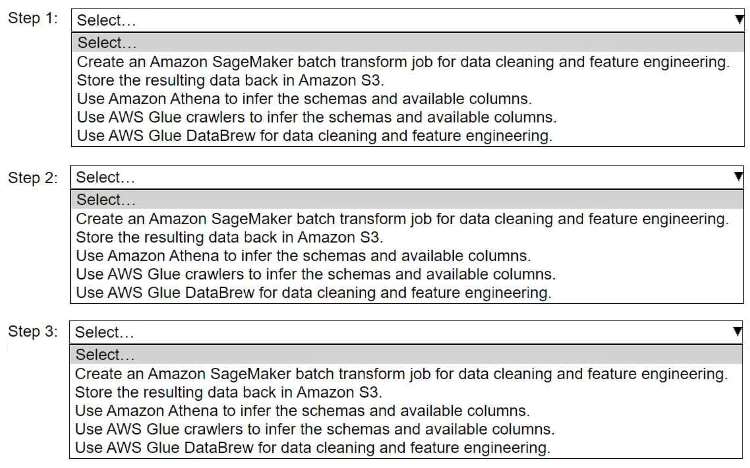
A company stores historical data in .csv files in Amazon S3. Only some of the rows and columns in the .csv files are populated. The columns are not labeled. An ML engineer needs to prepare and store the data so that the company can use the data to train ML models.
Select and order the correct steps from the following list to perform this task. Each step should be selected one time or not at all. (Select and order three.)
• Create an Amazon SageMaker batch transform job for data cleaning and feature engineering.
• Store the resulting data back in Amazon S3.
• Use Amazon Athena to infer the schemas and available columns.
• Use AWS Glue crawlers to infer the schemas and available columns.
• Use AWS Glue DataBrew for data cleaning and feature engineering.
Correct Answer:
See interactive view.
Explanation:
I agree with the community discussion answer. The correct sequence is: Step 1 - Use AWS Glue crawlers to infer schemas and available columns; Step 2 - Use AWS Glue DataBrew for data cleaning and feature engineering; Step 3 - Store the resulting data back in Amazon S3. This workflow follows the logical data preparation pipeline: first discover and catalog the data structure, then clean and transform it, and finally persist the prepared data for ML training.
Reason
Step 1 - AWS Glue crawlers is correct because crawlers are specifically designed to automatically discover and catalog data stored in S3, inferring schemas even from unlabeled CSV files with sparse data. They populate the AWS Glue Data Catalog with metadata about the data structure. Step 2 - AWS Glue DataBrew is correct because it is a visual data preparation tool purpose-built for data cleaning, normalization, and feature engineering tasks on structured datasets. It can handle missing values, column transformations, and feature creation without requiring code. Step 3 - Store resulting data back in Amazon S3 is correct because after cleaning and feature engineering, the prepared data must be persisted to S3 so it can be accessed by Amazon SageMaker for model training. S3 serves as the durable storage layer for ML workflows.
Why the other options are not as suitable
Create an Amazon SageMaker batch transform job for data cleaning and feature engineering is incorrect because SageMaker batch transform is designed for running inference on unlabeled data using an already-trained model, not for data preparation, cleaning, or feature engineering tasks. It expects preprocessed data as input. Use Amazon Athena to infer schemas and available columns is incorrect because while Athena can query data in S3, it requires either a predefined schema or integration with AWS Glue Data Catalog. It is a query engine, not a schema discovery tool. AWS Glue crawlers are the appropriate service for automatic schema inference and cataloging of raw data files.
Citations
-
Question 6
HOTSPOT -
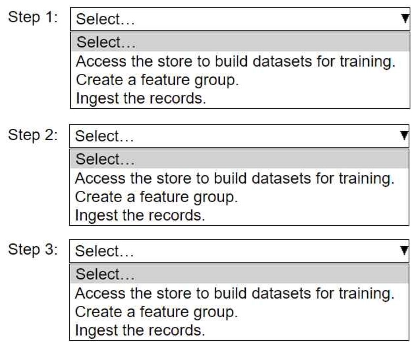
An ML engineer needs to use Amazon SageMaker Feature Store to create and manage features to train a model.
Select and order the steps from the following list to create and use the features in Feature Store. Each step should be selected one time. (Select and order three.)
• Access the store to build datasets for training.
• Create a feature group.
• Ingest the records.
Correct Answer:
See interactive view.
Explanation:
I agree with the suggested answer and the community discussion. The correct sequence for using Amazon SageMaker Feature Store is: Step 1 - Create a feature group, Step 2 - Ingest the records, Step 3 - Access the store to build datasets for training. This follows the logical workflow where you must first define the schema and structure (feature group), then populate it with data (ingest), and finally retrieve the data for model training (access).
Reason
Step 1 - Create a feature group: This is the foundational step where you define the schema, feature definitions, and metadata for your features. A feature group acts as a logical container that organizes related features and specifies how they will be stored (online, offline, or both). Without creating the feature group first, there is no structure to ingest data into. Step 2 - Ingest the records: Once the feature group schema is defined, you can populate it with actual feature data. The ingestion process uses the PutRecord API or batch ingestion methods to store feature values in the feature store. This step must come after creating the feature group because you need the target structure to exist before loading data. Step 3 - Access the store to build datasets for training: After features are ingested and available in the feature store, you can query and retrieve them to construct training datasets. This is done through the offline store (for batch training via S3) or online store (for real-time inference). This step logically follows ingestion because you need data present in the store before you can access it.
Why the other options are not as suitable
This is a sequencing question with three steps that must be arranged in the correct order. There are no explicitly labeled incorrect options (A, B, C, etc.), but any ordering other than Create → Ingest → Access would be incorrect. If you attempted to ingest records before creating a feature group: This would fail because there would be no defined schema or target structure to receive the data. SageMaker Feature Store requires the feature group to exist with a defined schema before any data can be written to it. If you attempted to access the store before ingesting records: You would retrieve no data or incomplete data because the feature store would be empty or unpopulated. The purpose of accessing the store is to build training datasets from ingested features, so ingestion must precede access. If you attempted to create a feature group after ingestion or access: This violates the fundamental prerequisite that the storage structure must exist before any operations can be performed on it.
Citations
-
Question 7
HOTSPOT -
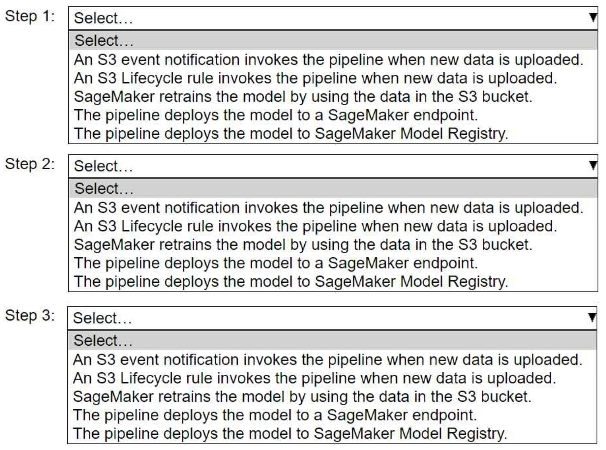
A company wants to host an ML model on Amazon SageMaker. An ML engineer is configuring a continuous integration and continuous delivery (Cl/CD) pipeline in AWS CodePipeline to deploy the model. The pipeline must run automatically when new training data for the model is uploaded to an Amazon S3 bucket.
Select and order the pipeline's correct steps from the following list. Each step should be selected one time or not at all. (Select and order three.)
• An S3 event notification invokes the pipeline when new data is uploaded.
• S3 Lifecycle rule invokes the pipeline when new data is uploaded.
• SageMaker retrains the model by using the data in the S3 bucket.
• The pipeline deploys the model to a SageMaker endpoint.
• The pipeline deploys the model to SageMaker Model Registry.
Correct Answer:
See interactive view.
Explanation:
I agree with the chosen answer. The correct sequence is: (1) An S3 event notification invokes the pipeline when new data is uploaded, (2) SageMaker retrains the model by using the data in the S3 bucket, and (3) The pipeline deploys the model to a SageMaker endpoint. This creates a complete CI/CD pipeline that automatically triggers on new training data, retrains the model, and deploys it to a production endpoint for inference. The question specifically states the pipeline must 'deploy the model', which requires deployment to an endpoint, not just registration in a model registry.
Reason
Step 1: An S3 event notification invokes the pipeline when new data is uploaded is correct because S3 event notifications are the standard AWS mechanism to trigger automated workflows when objects are created or modified in S3. This integrates with CodePipeline to start the CI/CD process automatically. Step 2: SageMaker retrains the model by using the data in the S3 bucket is correct because once triggered, the pipeline must execute a SageMaker training job using the newly uploaded data to create an updated model. This is the core ML operation in the pipeline. Step 3: The pipeline deploys the model to a SageMaker endpoint is correct because the question explicitly requires the pipeline to 'deploy the model'. Deployment to a SageMaker endpoint makes the model available for real-time inference, completing the CI/CD objective of getting the retrained model into production.
Why the other options are not as suitable
An S3 Lifecycle rule invokes the pipeline when new data is uploaded is incorrect because S3 Lifecycle rules are designed for object lifecycle management (transitioning objects to different storage classes or expiring them), not for event-driven triggers. They cannot invoke CodePipeline or Lambda functions directly and are not suitable for triggering CI/CD workflows. The pipeline deploys the model to SageMaker Model Registry is incorrect as the final step because while SageMaker Model Registry is useful for model versioning, cataloging, and governance, it does not deploy models for inference. Models in the registry must be explicitly deployed to an endpoint to serve predictions. The question requires the model to be deployed (made operational), not merely registered.
Citations
-
Question 8
HOTSPOT -
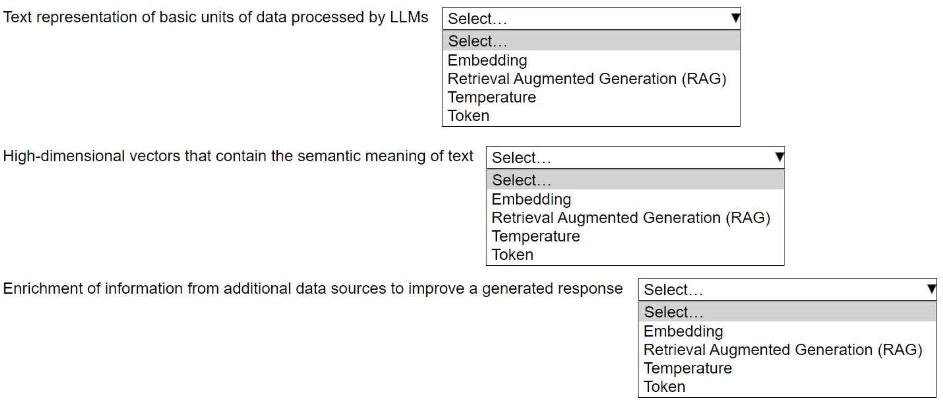
An ML engineer is building a generative AI application on Amazon Bedrock by using large language models (LLMs).
Select the correct generative AI term from the following list for each description. Each term should be selected one time or not at all. (Select three.)
• Embedding
• Retrieval Augmented Generation (RAG)
• Temperature
• Token
Correct Answer:
See interactive view.
Explanation:
I agree with the suggested answer. The correct matches are: Token for text representation of basic units of data processed by LLMs, Embedding for high-dimensional vectors that contain the semantic meaning of text, and Retrieval Augmented Generation (RAG) for enrichment of information from additional data sources to improve a generated response. These are fundamental generative AI concepts in Amazon Bedrock and LLM applications.
Reason
Token is correct for the first description because tokens are indeed the basic units of text that LLMs process - words, subwords, or characters broken down into discrete units for model input and output. Embedding is correct for the second description because embeddings are vector representations that encode text into high-dimensional numerical arrays capturing semantic meaning, enabling models to understand contextual relationships. Retrieval Augmented Generation (RAG) is correct for the third description because RAG is specifically designed to enrich generated responses by retrieving relevant information from external knowledge bases or data sources and combining it with the model's generative capabilities, improving accuracy and relevance.
Why the other options are not as suitable
Temperature does not match any of the three descriptions provided. Temperature is a hyperparameter that controls the randomness or creativity in model outputs by affecting the probability distribution over tokens during generation - higher values produce more diverse outputs while lower values produce more deterministic ones. It does not represent basic units of data, is not a vector representation of semantic meaning, and is not a technique for enriching responses with external data sources.
Citations
-
Question 9
HOTSPOT -
An ML engineer is working on an ML model to predict the prices of similarly sized homes. The model will base predictions on several features The ML engineer will use the following feature engineering techniques to estimate the prices of the homes:
• Feature splitting
• Logarithmic transformation
• One-hot encoding
• Standardized distribution
Select the correct feature engineering techniques for the following list of features. Each feature engineering technique should be selected one time or not at all (Select three.)
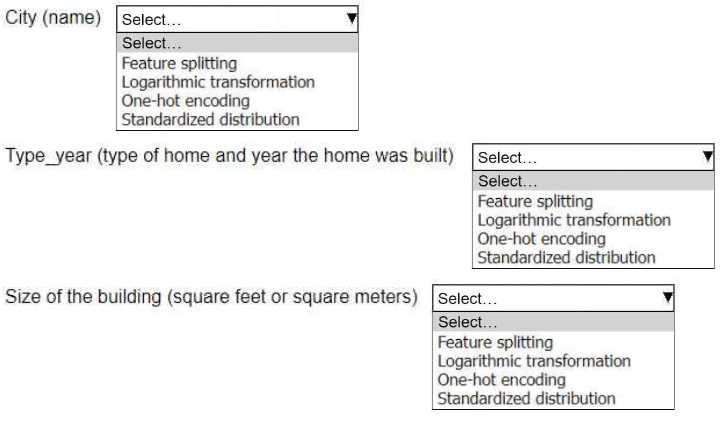
Correct Answer:
See interactive view.
Explanation:
I disagree with the suggested answer shown in the image. The community discussion provides a more compelling argument, particularly regarding the 'Size of the building' feature. The suggested answer applies Logarithmic transformation to building size, but given the problem statement specifically mentions 'similarly sized homes,' the data is unlikely to be skewed. The correct answer should be: City = One-hot encoding, Type_year = Feature splitting, Size of the building = Standardized distribution.
Reason
City (name) should use One-hot encoding because city names are categorical variables with no inherent ordering or numerical relationship. One-hot encoding creates binary columns for each unique city, allowing the model to treat each city independently without introducing artificial ordinal relationships. Type_year (type of home and year it was built) requires Feature splitting because it contains two distinct pieces of information combined in a single field: the type of home (categorical) and the year built (numerical). Splitting this compound feature allows each component to be processed appropriately—the type can be one-hot encoded and the year can be treated as a numerical feature. Size of the building (square feet or square meters) should use Standardized distribution because the problem explicitly states the model predicts prices for 'similarly sized homes,' indicating the size values likely follow a normal distribution without significant skew. Standardization (z-score normalization) scales the feature to have mean=0 and standard deviation=1, which is appropriate for numerical features with normal distributions and helps many ML algorithms converge faster.
Why the other options are not as suitable
Applying Logarithmic transformation to City (name) is incorrect because city names are categorical data, not numerical data. Logarithmic transformation only applies to continuous numerical features and cannot be applied to text labels. Using Feature splitting on City (name) is incorrect because city names are atomic categorical values that don't contain multiple pieces of information to separate. Using Standardized distribution on City (name) is incorrect because standardization requires numerical data with mean and standard deviation calculations, which cannot be performed on categorical text values. Applying Logarithmic transformation to Type_year is incorrect because while it could theoretically be applied after splitting, the feature first needs to be split into its components before any transformation. The primary engineering technique needed is feature splitting. Using One-hot encoding on Type_year is incorrect because the feature contains both categorical (type) and numerical (year) information combined. Direct one-hot encoding would treat each unique combination as a separate category rather than properly separating the two distinct pieces of information. Using Standardized distribution on Type_year is incorrect because the feature is a compound feature mixing categorical and numerical data, which cannot be directly standardized without first splitting. Applying Feature splitting to Size of the building is incorrect because building size is already a single atomic numerical value (square feet or square meters) with no compound information to separate. Using One-hot encoding on Size of the building is incorrect because size is a continuous numerical variable, not a categorical one. One-hot encoding would create separate binary columns for each unique size value, destroying the numerical relationship and ordinal nature of the data. The suggested answer's use of Logarithmic transformation for Size of the building is incorrect in this specific context because the problem states 'similarly sized homes,' indicating the size distribution is likely normal rather than skewed. Logarithmic transformation is typically used to normalize right-skewed distributions common in real estate data with wide size ranges, but that doesn't apply here.
Citations
-
Question 10
Case study -
An ML engineer is developing a fraud detection model on AWS. The training dataset includes transaction logs, customer profiles, and tables from an on-premises MySQL database. The transaction logs and customer profiles are stored in Amazon S3.
The dataset has a class imbalance that affects the learning of the model's algorithm. Additionally, many of the features have interdependencies. The algorithm is not capturing all the desired underlying patterns in the data.
Which AWS service or feature can aggregate the data from the various data sources?
- A. Amazon EMR Spark jobs
- B. Amazon Kinesis Data Streams
- C. Amazon DynamoDB
- D. AWS Lake Formation
Correct Answer:
D
Explanation:
I disagree with the suggested answer D. While AWS Lake Formation is designed for data lake management and can aggregate data from multiple sources, the question specifically asks which service can 'aggregate the data' in the context of developing an ML model. Amazon EMR Spark jobs (Option A) is the more appropriate choice because it provides the computational framework needed to actually perform the data aggregation, transformation, and feature engineering required for the fraud detection model. Lake Formation is better suited for data cataloging, governance, and orchestration, but the actual data processing and aggregation work is done by services like EMR Spark or AWS Glue (which Lake Formation orchestrates). For an ML engineer actively developing a model, EMR Spark provides the necessary processing power and flexibility to handle complex data transformations, address class imbalance, and engineer features from interdependent data.
Reason
Amazon EMR Spark jobs (Option A) is correct because it provides a distributed processing framework specifically designed to aggregate, transform, and process large datasets from multiple sources. Spark can natively connect to Amazon S3 for transaction logs and customer profiles, and can use JDBC connectors to read from on-premises MySQL databases. EMR Spark is particularly well-suited for ML workloads because it can handle complex data transformations, feature engineering to address interdependencies between features, and techniques like SMOTE or undersampling to handle class imbalance. Spark's DataFrame API and MLlib library make it ideal for preparing data for fraud detection models. The service provides the computational power needed to actually perform the aggregation and transformation work required before model training.
Why the other options are not as suitable
- Option B is incorrect because Amazon Kinesis Data Streams is designed for real-time streaming data ingestion and delivery, not for aggregating historical batch data from S3 and on-premises databases. It would be suitable for real-time fraud detection but not for aggregating the training dataset described in the scenario.
- Option C is incorrect because Amazon DynamoDB is a NoSQL database service, not a data aggregation or ETL tool. While it could store aggregated data, it cannot perform the aggregation of data from S3 and MySQL sources, nor does it provide the processing capabilities needed for feature engineering and handling class imbalance.
- Option D (AWS Lake Formation) is incorrect in this context because while it can orchestrate data ingestion from multiple sources and manage a data lake, it is primarily a governance and cataloging service that sits on top of other services like AWS Glue. Lake Formation itself doesn't perform the actual data aggregation and transformation work—it relies on Glue ETL jobs or other processing engines. For an ML engineer actively developing a model who needs to aggregate and transform data, EMR Spark provides more direct control and processing capabilities.
Citations
About This Practice Material
This is independent study material to help you prepare for the AWS ML Engineer Associate (MLA-C01) exam. It is not affiliated with, endorsed by, or sponsored by Amazon or any certification body. All product names, certification names, trademarks, and exam codes are the property of their respective owners and are used here for descriptive (nominative) purposes only.
We do not provide real exam questions, brain dumps, or any guarantee of passing. All questions are original practice items compiled from publicly available community discussions and AI-generated explanations, aligned to the publicly available exam objectives.