EC-Council Ethical Hacker v12 (CEH, 312-50v12) Practice Questions & Study Guide
The Certified Ethical Hacker (CEH) v12 (312-50v12) is the premier certification for security professionals who want to demonstrate their mastery of ethical hacking and penetration testing. As cyber threats become more sophisticated and prevalent, the ability to think like a hacker and identify vulnerabilities before they can be exploited has become a highly sought-after skill. Managed by EC-Council, the CEH v12 validates your expertise in leveraging the latest hacking tools and techniques to protect an organization's most sensitive data and infrastructure. It is an essential credential for any professional looking to build a career in offensive security and prove their technical prowess.
Overview of the Exam
The 312-50v12 exam is a rigorous assessment that covers the core technologies and techniques used in ethical hacking. It is a four-hour exam consisting of 125 multiple-choice questions. The exam is designed to test your technical expertise and your ability to apply ethical hacking best practices to real-world security scenarios. From footprinting and reconnaissance to malware analysis and cloud security, the CEH v12 ensures that you have the skills necessary to identify and mitigate the most advanced cyber threats. Achieving the CEH v12 certification proves that you are a highly skilled professional capable of leading complex security assessment projects.
Target Audience
The CEH v12 is intended for security professionals who have a solid understanding of ethical hacking and penetration testing. It is ideal for individuals in roles such as:
1. Ethical Hackers and Penetration Testers
2. Security Analysts and Engineers
3. Systems Administrators
4. Network Administrators
5. Security Consultants
To be successful, candidates should have at least two years of experience in the security field and a thorough understanding of the CEH v12 curriculum.
Key Topics Covered
The 312-50v12 exam is organized into several main domains:
1. Information Security and Ethical Hacking Overview: Understanding core security principles and the ethical hacking process.
2. Reconnaissance Techniques: Implementing footprinting, scanning, and enumeration techniques.
3. System Hacking Phases and Attack Techniques: Understanding and applying various hacking techniques, including malware analysis and social engineering.
4. Network and Device Hacking: Implementing hacking techniques for networks, wireless environments, and mobile devices.
5. Web Application and Database Hacking: Identifying and exploiting vulnerabilities in web applications and databases.
6. Cloud Computing and IoT Hacking: Understanding hacking techniques for cloud environments and IoT devices.
7. Cryptography: Understanding and applying cryptographic principles and techniques.
Benefits of Getting Certified
Earning the CEH v12 certification provides several significant benefits. First, it offers industry recognition of your elite expertise in ethical hacking and penetration testing. As a leader in the security industry, EC-Council skills are in high demand across the globe. Second, it can lead to increased career opportunities and higher salary potential in a variety of roles. Third, it demonstrates your commitment to professional excellence and your dedication to staying current with the latest offensive security practices. By holding this certification, you join a global community of ethical hackers and gain access to exclusive resources and continuing education opportunities.
Why Choose NotJustExam.com for Your CEH Prep?
The 312-50v12 exam is challenging and requires a deep understanding of complex hacking tools and techniques. NotJustExam.com is the best resource to help you master this material. Our platform offers an extensive bank of practice questions that are designed to mirror the actual exam’s format and difficulty.
What makes NotJustExam.com stand out is our focus on interactive logic and the accuracy of our explanations. We don’t just provide a list of questions; we provide a high-quality learning experience. Every question in our bank includes an in-depth, accurate explanation that helps you understand the technical reasoning behind the correct hacking solution. This ensures that you are truly learning the material and building the confidence needed to succeed on the exam. Our content is regularly updated to reflect the latest hacking trends and CEH v12 updates. With NotJustExam.com, you can approach your CEH exam with the assurance that comes from thorough, high-quality preparation. Start your journey toward becoming a Certified Ethical Hacker today with us!
Free EC-Council Ethical Hacker v12 (CEH, 312-50v12) Practice Questions Preview
-
Question 1
In this form of encryption algorithm, every individual block contains 64-bit data, and three keys are used, where each key consists of 56 bits. Which is this encryption algorithm?
- A. IDEA
- B. Triple Data Encryption Standard
- C. AES
- D. MD5 encryption algorithm
Correct Answer:
B
Explanation:
The AI also suggests answer B, Triple Data Encryption Standard (3DES).
The suggested answer agrees with the suggested answer B.
Reasoning: The question describes the characteristics of Triple DES (3DES). 3DES is a symmetric-key block cipher that applies the Data Encryption Standard (DES) cipher algorithm three times to each data block. DES uses 56-bit keys and operates on 64-bit blocks. The 3DES uses three 56-bit keys which makes a total of 168 bits to increase the key size and improve security over single DES. This matches the question's description of a 64-bit block size and the use of three 56-bit keys.
Reasons for not choosing other answers:
- A. IDEA (International Data Encryption Algorithm): IDEA uses 128-bit keys and operates on 64-bit blocks, but does not use three keys each consisting of 56 bits.
- C. AES (Advanced Encryption Standard): AES supports various key sizes (128, 192, or 256 bits) and operates on 128-bit blocks. It doesn't use 56-bit keys, nor does it use three keys.
- D. MD5: MD5 is a hashing algorithm, not an encryption algorithm. It produces a 128-bit hash value and does not use keys in the same way as encryption algorithms. It's also not reversible.
In summary, the detailed description in the question clearly points to Triple DES as the correct answer.
Citations:
- Triple DES, https://en.wikipedia.org/wiki/Triple_DES
- Data Encryption Standard, https://en.wikipedia.org/wiki/Data_Encryption_Standard
- Advanced Encryption Standard, https://en.wikipedia.org/wiki/Advanced_Encryption_Standard
- MD5, https://en.wikipedia.org/wiki/MD5
- International Data Encryption Algorithm, https://en.wikipedia.org/wiki/International_Data_Encryption_Algorithm
-
Question 2
John is investigating web-application firewall logs and observers that someone is attempting to inject the following:
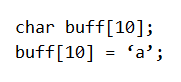
What type of attack is this?
- A. SQL injection
- B. Buffer overflow
- C. CSRF
- D. XSS
Correct Answer:
B
Explanation:
The AI assistant agrees with the suggested answer, which is B (Buffer overflow).
Reasoning: The provided code snippet shows an attempt to write data beyond the allocated buffer size. The array `buff` is declared to hold 10 characters (indices 0-9). The code `buff[10] = 'A';` attempts to write to the 11th element, which is outside the bounds of the allocated memory. This is a classic example of a buffer overflow.
Why other options are incorrect:
- SQL injection: SQL injection involves injecting malicious SQL code into an application's database queries. The given code snippet doesn't interact with any database or SQL queries.
- CSRF (Cross-Site Request Forgery): CSRF exploits trust between a user and a website to trick the user into performing unintended actions. The code snippet does not demonstrate any CSRF attempt.
- XSS (Cross-Site Scripting): XSS involves injecting malicious scripts into websites viewed by other users. The code snippet doesn't inject any scripts into a web page.
Therefore, based on the code snippet, the most appropriate answer is Buffer overflow.
Citations:
- Buffer Overflow, https://owasp.org/www-community/vulnerabilities/Buffer_Overflow
-
Question 3
John, a professional hacker, performs a network attack on a renowned organization and gains unauthorized access to the target network. He remains in the network without being detected for a long time and obtains sensitive information without sabotaging the organization.
Which of the following attack techniques is used by John?
- A. Insider threat
- B. Diversion theft
- C. Spear-phishing sites
- D. Advanced persistent threat
Correct Answer:
D
Explanation:
The AI agrees with the suggested answer.
The suggested answer is D: Advanced persistent threat.
Reasoning: The question describes a scenario where an attacker gains unauthorized access to a network, remains undetected for a prolonged period, and extracts sensitive information without causing immediate damage. This perfectly aligns with the definition of an Advanced Persistent Threat (APT). APTs are characterized by their stealth, persistence, and focus on long-term data exfiltration rather than immediate disruption.
Why other options are incorrect:
- A. Insider threat: An insider threat involves a malicious actor who already has legitimate access to the organization's systems or data. The question specifies an external hacker gaining unauthorized access.
- B. Diversion theft: Diversion theft typically refers to the misdirection of physical assets. This is not relevant in the context of a network attack focused on data exfiltration.
- C. Spear-phishing sites: While spear-phishing *could* be used as an initial attack vector in an APT, the question describes the attacker's behavior *after* gaining access, not the initial method of entry. Also, spear-phishing refers to a specific type of phishing attack and not the overall threat.
Therefore, based on the scenario described, APT is the most appropriate answer.
Supporting Citations:
- Advanced Persistent Threat (APT), https://www.cisa.gov/uscert/glossary?term=advanced%20persistent%20threat
- What is an Advanced Persistent Threat (APT)?, https://www.crowdstrike.com/cybersecurity-101/advanced-persistent-threat-apt/
- NIST definition of APT, https://csrc.nist.gov/glossary/term/advanced_persistent_threat
-
Question 4
You are attempting to run an Nmap port scan on a web server. Which of the following commands would result in a scan of common ports with the least amount of noise in order to evade IDS?
- A. nmap -A - Pn
- B. nmap -sP -p-65535 -T5
- C. nmap -sT -O -T0
- D. nmap -A --host-timeout 99 -T1
Correct Answer:
C
Explanation:
The suggested answer is C. The question asks for the command that scans common ports with the least noise to evade IDS.
Option C (nmap -sT -O -T0) is the most suitable choice because it uses the -T0 timing option (paranoid), which minimizes noise and makes it harder for an IDS to detect the scan. -sT initiates a TCP connect scan, and -O attempts OS detection which might add a bit of noise but is still less noisy than other options.
Here's why the other options are less suitable:
- Option A (nmap -A -Pn): The -A option enables aggressive scan mode, which includes OS detection, version detection, script scanning, and traceroute. This generates a lot of noise and is easily detected by an IDS. -Pn skips host discovery, which isn't related to noise level during port scanning itself.
- Option B (nmap -sP -p-65535 -T5): The -sP option performs a ping scan, which only discovers hosts but does not scan ports. While specifying all ports (-p-65535) might seem like a thorough scan, it is combined with -sP and therefore won't perform the port scanning asked in the question. -T5 is the fastest timing template, which increases the noise level significantly.
- Option D (nmap -A --host-timeout 99 -T1): Again, the -A option enables aggressive scan mode, which generates a lot of noise. -T1 is a slower timing template than -T5, but still not as stealthy as -T0. --host-timeout 99 sets a timeout for each host, but does not minimize the noise.
Therefore, option C provides the quietest scan for evading IDS while still performing a TCP connect scan and OS detection.
In summary, the AI agrees with the suggested answer C.
-
Question 5
This wireless security protocol allows 192-bit minimum-strength security protocols and cryptographic tools to protect sensitive data, such as GCMP-256, HMAC-SHA384, and ECDSA using a 384-bit elliptic curve.
Which is this wireless security protocol?
- A. WPA3-Personal
- B. WPA3-Enterprise
- C. WPA2-Enterprise
- D. WPA2-Personal
Correct Answer:
B
Explanation:
The AI agrees with the suggested answer.
The suggested answer is B. WPA3-Enterprise.
Reasoning: WPA3-Enterprise mandates the use of 192-bit minimum-strength security protocols and cryptographic tools such as GCMP-256, HMAC-SHA384, and ECDSA using a 384-bit elliptic curve to protect sensitive data. These stronger cryptographic methods are specifically a feature of WPA3-Enterprise.
Here's why the other options are less likely:
- WPA3-Personal: While WPA3-Personal offers enhanced security features compared to WPA2, it doesn't emphasize the 192-bit minimum-strength security protocols and specific cryptographic tools like GCMP-256, HMAC-SHA384, and ECDSA with a 384-bit elliptic curve as strongly as WPA3-Enterprise.
- WPA2-Enterprise and WPA2-Personal: These are older protocols and do not support the advanced cryptographic suites mentioned in the question. They use weaker encryption standards compared to WPA3.
Citations:
- Wi-Fi Security - WPA3 - Revolution Wi-Fi, https://www.revolutionwifi.net/revolutionwifi/p/wpa3-wi-fi-security
-
Question 6
What are common files on a web server that can be misconfigured and provide useful information for a hacker such as verbose error messages?
- A. httpd.conf
- B. administration.config
- C. php.ini
- D. idq.dll
Correct Answer:
C
Explanation:
The AI agrees with the suggested answer C (php.ini).
Reasoning:
The question asks about common web server files that, when misconfigured, can provide useful information to hackers through verbose error messages. While several configuration files can be misconfigured, php.ini is particularly relevant due to its direct control over PHP error reporting. Verbose error messages, often enabled or inadvertently left enabled in development environments, can reveal sensitive information such as file paths, database credentials, and internal application workings, making php.ini a prime target for attackers.
Why other options are less likely:
- A. httpd.conf: While misconfigurations in httpd.conf (the Apache web server configuration file) can create vulnerabilities, it is less directly responsible for verbose application-level error messages than php.ini. httpd.conf primarily controls server-wide settings and virtual host configurations, not the error reporting behavior of PHP applications.
- B. administration.config: This file name is not a standard or commonly recognized configuration file in web server environments. Therefore, it is unlikely to be a significant source of misconfiguration-related information leakage.
- D. idq.dll: This file is associated with the Internet Data Query (IDQ) component of older versions of Microsoft's Internet Information Services (IIS) web server, primarily used for indexing and search functionality. While vulnerabilities could exist in its configuration or related components, it is less directly related to verbose application error reporting than php.ini and is specific to IIS servers, not a general web server file.
Thus, php.ini is the most direct and commonly exploited source of verbose error messages on web servers using PHP.
Therefore, the final answer is C. php.ini
Citations:
- PHP: Documentation - php.ini, https://www.php.net/manual/en/ini.core.php
- OWASP: Top Ten Web Application Security Risks, https://owasp.org/www-project-top-ten/
-
Question 7
Gerard, a disgruntled ex-employee of Sunglass IT Solutions, targets this organization to perform sophisticated attacks and bring down its reputation in the market. To launch the attacks process, he performed DNS footprinting to gather information about DNS servers and to identify the hosts connected in the target network. He used an automated tool that can retrieve information about DNS zone data including DNS domain names, computer names, IP addresses, DNS records, and network Whois records. He further exploited this information to launch other sophisticated attacks.
What is the tool employed by Gerard in the above scenario?
- A. Towelroot
- B. Knative
- C. zANTI
- D. Bluto
Correct Answer:
D
Explanation:
The suggested answer is D, which is Bluto. The AI agrees with this answer.
Reasoning:
The question describes a scenario where an attacker uses an automated tool to gather DNS information, including domain names, IP addresses, and DNS records, to footprint a target network. Bluto is specifically designed for DNS footprinting and reconnaissance. The tool's capabilities align perfectly with the actions described in the question.
The question states that the tool retrieves information about DNS zone data including DNS domain names, computer names, IP addresses, DNS records, and network Whois records.
Why other options are incorrect:
- Towelroot: This is an Android rooting tool, not related to DNS footprinting.
- Knative: This is a Kubernetes-based platform to build, deploy, and manage modern serverless workloads, it's not a DNS footprinting tool.
- zANTI: This is a mobile penetration testing toolkit, while it includes network scanning capabilities, it is not primarily focused on DNS footprinting like Bluto.
Suggested Answer: D. Bluto
Citations:
- Bluto - DNS Audit Tool, https://github.com/Hood3dRob1n/Bluto
- Towelroot, https://towelroot.com/
- Knative, https://knative.dev/
-
Question 8
Tony is a penetration tester tasked with performing a penetration test. After gaining initial access to a target system, he finds a list of hashed passwords.
Which of the following tools would not be useful for cracking the hashed passwords?
- A. Hashcat
- B. John the Ripper
- C. THC-Hydra
- D. netcat
Correct Answer:
D
Explanation:
The AI agrees with the suggested answer.
The correct answer is D. netcat.
Here's why:
Netcat is a networking utility used for reading from and writing to network connections using TCP or UDP. It is not designed for password cracking. It's primarily used for network debugging, port scanning, and data transfer.
Hashcat and John the Ripper are specifically designed for password cracking, utilizing various techniques to recover passwords from hashes. THC-Hydra is a brute-force password cracking tool used against network services.
Therefore, netcat would not be useful in cracking hashed passwords.
- A. Hashcat: This is a popular password cracking tool, making it unsuitable as the answer.
- B. John the Ripper: Similar to Hashcat, John the Ripper is designed for password cracking.
- C. THC-Hydra: This is a brute-force password cracking tool specifically for network services, meaning it's not the right answer.
-
Question 9
Which of the following Google advanced search operators helps an attacker in gathering information about websites that are similar to a specified target URL?
- A. [inurl:]
- B. [info:]
- C. [site:]
- D. [related:]
Correct Answer:
D
Explanation:
The suggested answer is D. [related:].
The AI agrees with the suggested answer, which is D. [related:].
Reasoning:
The 'related:' operator is specifically designed to find websites that are similar to a given URL. This is valuable for attackers to discover potential targets or to understand the ecosystem surrounding a target.
Why other options are incorrect:
- A. [inurl:]: This operator searches for specific keywords within the URL of a webpage. While useful for information gathering, it doesn't identify similar websites.
- B. [info:]: This operator provides information about a specific webpage, such as the cached version or similar pages (functionality overlapping with 'related:'), but is not the primary operator for finding *related* sites.
- C. [site:]: This operator restricts search results to a specific domain or website. It doesn't find similar websites across different domains.
Therefore, the '[related:]' operator is the most appropriate choice for finding websites similar to a specified target URL.
-
Question 10
You are a penetration tester working to test the user awareness of the employees of the client XYZ. You harvested two employees’ emails from some public sources and are creating a client-side backdoor to send it to the employees via email.
Which stage of the cyber kill chain are you at?
- A. Reconnaissance
- B. Weaponization
- C. Command and control
- D. Exploitation
Correct Answer:
B
Explanation:
The AI agrees with the suggested answer, B. Weaponization.
The reason for choosing Weaponization is that the scenario describes the penetration tester as actively creating a client-side backdoor, which is the "weapon" in this context. The tester is preparing the malicious payload (backdoor) to be delivered via email. This aligns directly with the definition of the Weaponization phase in the Cyber Kill Chain.
Here's why the other options are less likely:
- Reconnaissance: This phase involves gathering information about the target. While the tester harvested emails, that was a precursor to the actual attack, not the primary activity described in the question.
- Exploitation: This phase is when the weapon is delivered and triggers the vulnerability. The backdoor hasn't been sent yet, so exploitation hasn't occurred.
- Command and Control: This phase occurs after successful exploitation, where the attacker establishes communication with the compromised system. The scenario hasn't reached this stage.
Therefore,
the creation of the backdoor is the defining action that places the tester firmly in the Weaponization stage.
Citations:
- Cyber Kill Chain, https://www.lockheedmartin.com/en-us/capabilities/cyber/cyber-kill-chain
About This Practice Material
This is independent study material to help you prepare for the EC-Council Ethical Hacker v12 (CEH, 312-50v12) exam. It is not affiliated with, endorsed by, or sponsored by ECCouncil or any certification body. All product names, certification names, trademarks, and exam codes are the property of their respective owners and are used here for descriptive (nominative) purposes only.
We do not provide real exam questions, brain dumps, or any guarantee of passing. All questions are original practice items compiled from publicly available community discussions and AI-generated explanations, aligned to the publicly available exam objectives.