Juniper Routing & Switching (JNCIS-ENT, JN0-351) Practice Questions & Study Guide
The Enterprise Routing and Switching, Specialist (JNCIS-ENT) JN0-351 certification is a key milestone for networking professionals who work with Juniper Networks' enterprise-grade routing and switching technologies. As organizations continue to evolve their network architectures to support digital transformation, the ability to implement and manage robust, scalable, and secure enterprise networks has become a highly sought-after skill. The JN0-351 validates your specialist-level knowledge of Junos OS, including core routing and switching technologies. It is an essential credential for any network professional looking to advance their career and prove their technical mastery with Juniper solutions.
Overview of the Exam
The JN0-351 exam is a rigorous assessment that covers the implementation and management of Juniper Networks' enterprise-grade routing and switching solutions. It is a 90-minute exam consisting of 65 multiple-choice questions. The exam is designed to test your technical expertise and your ability to apply Juniper Networks best practices to real-world networking scenarios. From advanced Layer 2 and Layer 3 technologies to Junos OS configuration and troubleshooting, the JN0-351 ensures that you have the skills necessary to build and maintain modern enterprise networks. Achieving the JN0-351 certification proves that you are a highly skilled professional who can handle the technical demands of enterprise-grade networking.
Target Audience
The JN0-351 is intended for network professionals who have a solid understanding of Juniper Networks' enterprise-grade networking technologies. It is ideal for individuals in roles such as:
1. Network Engineers
2. Network Administrators
3. Systems Engineers
4. Network Architects
To be successful, candidates should have at least three to five years of experience in enterprise-grade networking and a thorough understanding of the Junos OS and its features.
Key Topics Covered
The JN0-351 exam is organized into several main domains:
1. Layer 2 Switching and VLANs: Configuring and managing advanced Layer 2 technologies, including VLANs and Spanning Tree Protocol (STP).
2. Spanning Tree Protocol: Understanding and implementing various STP versions, including RSTP and MSTP.
3. Layer 2 Security: Implementing security features like DHCP snooping and dynamic ARP inspection (DAI).
4. Protocol Independent Routing: Configuring static, aggregate, and generated routes.
5. Open Shortest Path First (OSPF): Implementing and troubleshooting OSPFv2 and OSPFv3.
6. Border Gateway Protocol (BGP): Configuring and managing BGP for enterprise routing.
7. Tunnels: Implementing various tunneling technologies, including GRE and IP-IP.
8. High Availability: Configuring and managing high-availability features like VRRP.
Benefits of Getting Certified
Earning the JN0-351 certification provides several significant benefits. First, it offers industry recognition of your specialized expertise in Juniper Networks technologies. As a leader in the networking industry, Juniper skills are in high demand across the globe. Second, it can lead to increased career opportunities and higher salary potential in a variety of roles. Third, it demonstrates your commitment to professional excellence and your dedication to staying current with the latest networking practices. By holding this certification, you join a global community of Juniper professionals and gain access to exclusive resources and continuing education opportunities.
Why Choose NotJustExam.com for Your JN0-351 Prep?
The JN0-351 exam is challenging and requires a deep understanding of Juniper Networks' complex features. NotJustExam.com is the best resource to help you master this material. Our platform offers an extensive bank of practice questions that are designed to mirror the actual exam’s format and difficulty.
What makes NotJustExam.com stand out is our focus on interactive logic and the accuracy of our explanations. We don’t just provide a list of questions; we provide a high-quality learning experience. Every question in our bank includes an in-depth, accurate explanation that helps you understand the technical reasoning behind the correct networking solutions. This ensures that you are truly learning the material and building the confidence needed to succeed on the exam. Our content is regularly updated to reflect the latest Juniper features and exam updates. With NotJustExam.com, you can approach your JN0-351 exam with the assurance that comes from thorough, high-quality preparation. Start your journey toward becoming a Certified Juniper Professional today with us!
Free Juniper Routing & Switching (JNCIS-ENT, JN0-351) Practice Questions Preview
-
Question 1
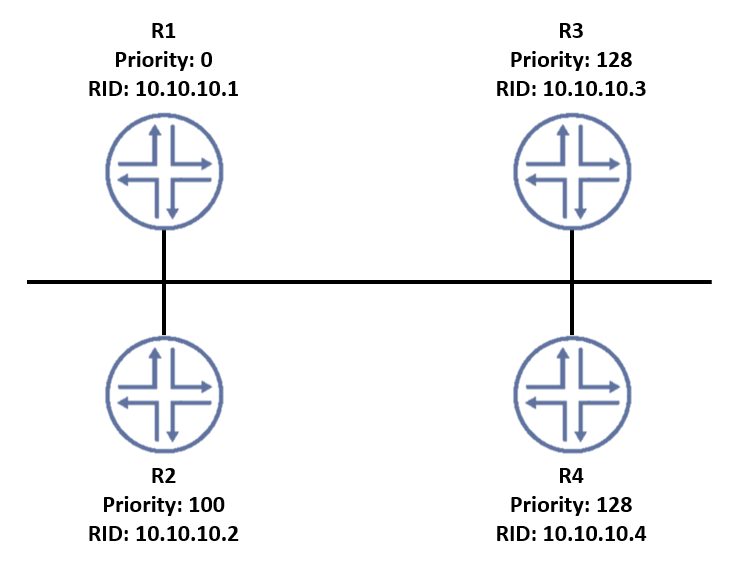
Referring to the exhibit, which router will become the OSPF BDR if all routers are powered on at the same time?
Correct Answer:
C
Explanation:
The AI agrees with the suggested answer.
The suggested answer is C. R3.
Reasoning: In OSPF, the Designated Router (DR) and Backup Designated Router (BDR) are elected based on priority and Router ID (RID). When routers boot up simultaneously, the router with the highest priority becomes the DR. If there's a tie in priority, the router with the highest RID wins. The BDR election follows the same process; the router with the next highest priority (or RID, if priorities are equal) becomes the BDR.
Based on the information in the discussion content:
- R4 has the highest RID and becomes the DR.
- R3 has the second highest priority and RID, thus becoming the BDR.
- R1 with priority 0 will not become DR or BDR.
Therefore,
R3 will become the BDR.
- A. R4 is incorrect because R4 becomes the DR due to its highest RID.
- B. R1 is incorrect because R1 has a priority of 0, which means it's ineligible to become DR or BDR.
- D. R2 is incorrect as it doesn't have the second highest priority or RID compared to R3.
-
Question 2
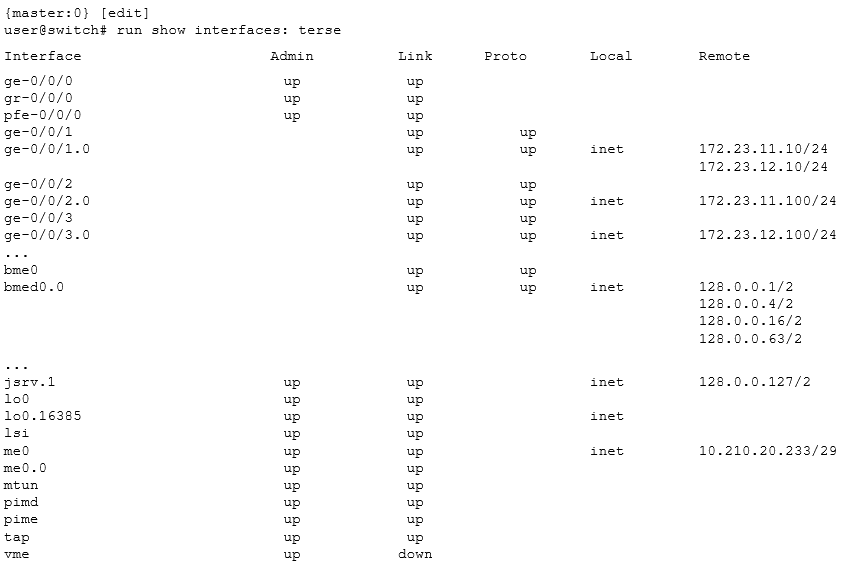
What is the management IP address of the device shown in the exhibit?
- A. 10.210.20.233
- B. 172.23.12.100
- C. 128.0.0.1
- D. 172.23.11.10
Correct Answer:
A
Explanation:
Based on the question and discussion, the AI agrees with the suggested answer, which is A (10.210.20.233).
The reason is that the management IP address is typically configured on a dedicated management interface, such as me0, and the IP address associated with that interface is 10.210.20.233 as seen on the exhibit.
The other options are not the IP addresses configured for the management interface (me0).
-
Question 3
Which three protocols support BFD? (Choose three.)
- A. RSTP
- B. BGP
- C. OSPF
- D. LACP
- E. FTP
Correct Answer:
BCD
Explanation:
The AI recommends the answer BCD, which corresponds to BGP, OSPF, and LACP.
The primary reason is that BFD (Bidirectional Forwarding Detection) is designed to provide fast failure detection for various protocols, including routing protocols like BGP and OSPF, as well as link aggregation protocols like LACP.
Here's a breakdown:
- BGP: BFD can be used to quickly detect path failures between BGP peers, allowing for faster convergence.
- OSPF: OSPF can integrate with BFD to rapidly detect link failures, improving network resilience.
- LACP: BFD can be configured to work with LACP to monitor the health of aggregated links.
The other options are incorrect because:
- RSTP (Rapid Spanning Tree Protocol): RSTP is a link-layer protocol for preventing loops in a network. While it deals with network topology and link states, it doesn't directly integrate with BFD for failure detection in the same way as routing protocols or LACP.
- FTP (File Transfer Protocol): FTP is an application-layer protocol used for transferring files and is not related to BFD.
Therefore, based on the purpose and typical usage of BFD, BGP, OSPF, and LACP are the correct choices.
-
Question 4
Which statement is correct about graceful Routing Engine switchover (GRES)?
- A. The PFE restarts and the kernel and interface information is lost.
- B. GRES has a helper mode and are starting mode.
- C. When combined with NSR, routing is preserved and the new master RE does not restart rpd.
- D. With no other high availability features enabled, routing is preserved and the new master RE does not restart rpd.
Correct Answer:
C
Explanation:
The AI agrees with the suggested answer.
The correct answer is C.
Reasoning: When Graceful Routing Engine Switchover (GRES) is combined with Nonstop Active Routing (NSR), routing information is preserved during a switchover, and the new master Routing Engine (RE) does not restart the routing protocol daemon (rpd). This ensures minimal disruption to network traffic.
Why other options are incorrect:
- A: This statement is incorrect because with GRES, the Packet Forwarding Engine (PFE) does *not* restart, and kernel and interface information are *not* lost. GRES is designed to maintain forwarding during a switchover.
- B: GRES operates in active and standby modes, not helper and starting modes. The primary RE is active, and the backup RE is in standby mode, ready to take over if the primary fails.
- D: Without NSR, routing is *not* preserved during a GRES. The routing protocol daemon (rpd) restarts on the new master RE, which causes a disruption in routing.
Citations:
- Understanding Graceful Routing Engine Switchover, https://www.juniper.net/documentation/us/en/software/junos/high-availability/topics/topic-map/graceful-switchover-understanding.html
- Graceful Routing Engine Switchover, https://www.juniper.net/documentation/software/junos/junos96/swconfig-high-availability/html/graceful-switchover.html
-
Question 5
Which statement is correct about controlling the routes installed by a RIB group?
- A. An import policy is applied to the RIB group.
- B. Only routes in the last table are installed
- C. A firewall filter must be configured to install routes in the RIB groups.
- D. An export policy is applied to the RIB group.
Correct Answer:
A
Explanation:
The AI agrees with the suggested answer of A.
The correct statement about controlling the routes installed by a RIB group is that an import policy is applied to the RIB group.
Reasoning:
RIB groups are used to share routing information between different routing instances. To control which routes are installed into a RIB group, an import policy is applied.
This policy filters the routes being imported into the RIB group, allowing you to specify criteria such as route source, destination, or other attributes. Only routes that match the policy criteria are installed in the RIB group.
This mechanism ensures that only desired routes are propagated, maintaining control over the routing information within the specific RIB group.
Why other options are incorrect:
B. Only routes in the last table are installed: This statement is incorrect because the routes installed into a RIB group depend on the applied import policy, not just the last table.
C. A firewall filter must be configured to install routes in the RIB groups: While firewall filters can influence routing indirectly, they are not the primary mechanism for controlling routes installed in RIB groups. Import policies are used for this purpose.
D. An export policy is applied to the RIB group: Export policies are used to control which routes are advertised *from* a routing table, not which routes are installed *into* a RIB group.
Citations:
- Juniper Documentation on Routing Policies, https://www.juniper.net/documentation/us/en/software/junos/routing-policy/topics/topic-map/policy-statement-understanding.html
-
Question 6
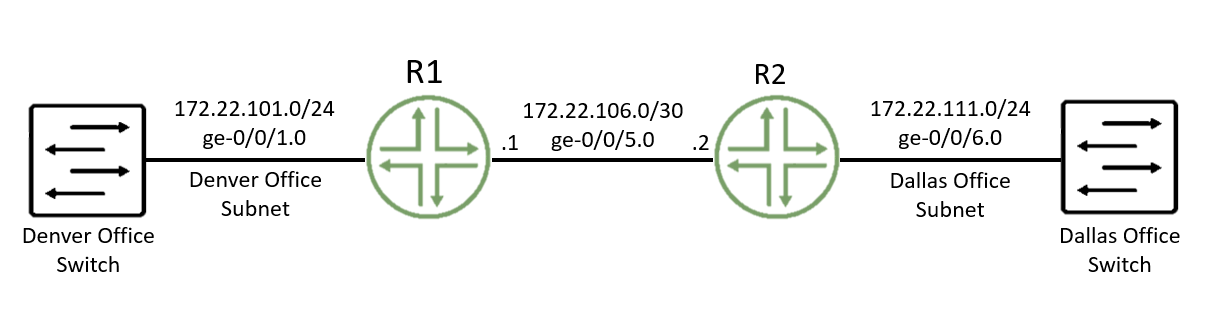
You are using OSPF to advertise the subnets that are used by the Denver and Dallas offices. The routers that are directly connected to the Dallas and Denver subnets are not advertising the connected subnets.
Referring to the exhibit, which two statements are correct? (Choose two.)
- A. Create static routes on the switches using the local vMX router's loopback interface for the next hop.
- B. Configure and apply a routing policy that redistributes the Dallas and Denver subnets using Type 5 LSAs.
- C. Configure and apply a routing policy that redistributes the connected Dallas and Denver subnets.
- D. Enable the passive option on the OSPF interfaces that are connected to the Dallas and Denver subnets.
Correct Answer:
CD
Explanation:
The AI agrees with the suggested answer of C and D. Here's a detailed breakdown of why:
Reasoning for Choosing C:
Configuring and applying a routing policy that redistributes the connected Dallas and Denver subnets is a standard method for advertising these subnets via OSPF. The routers directly connected to these subnets may not be advertising them for a variety of reasons, such as a missing "network" statement in the OSPF configuration, or a filtering policy that is preventing advertisement. Redistributing connected routes ensures that these subnets are injected into the OSPF domain. This is a common practice when dealing with directly connected routes that are not being advertised as expected. This method is preferred because it directly addresses the problem of the subnets not being advertised.
Reasoning for Choosing D:
Enabling the passive option on the OSPF interfaces connected to the Dallas and Denver subnets prevents the router from forming OSPF adjacencies on those interfaces. This means the router will not attempt to establish neighbor relationships with any devices (likely switches in this scenario) connected to those subnets. While it might seem counterintuitive to disable adjacencies, this is often done when the connected device doesn't participate in OSPF routing (e.g., a simple switch). Enabling passive mode still allows the router to advertise the connected subnet; it simply stops it from trying to form a neighbor relationship. This reduces unnecessary OSPF traffic and processing overhead. This is correct because the switches don't need to form an OSPF adjacency. The router only needs to advertise the subnet.
Reasoning for Not Choosing A:
Creating static routes on the switches using the vMX router's loopback interface as the next hop is not the correct approach. The switches are not running OSPF, so configuring static routes on them would not solve the problem of advertising the Dallas and Denver subnets *within* the OSPF domain. Also, using the loopback interface as the next hop for directly connected subnets doesn't make sense. The next hop should be the interface on the vMX router that is directly connected to the switch. The problem specifies the routers connected to the Dallas and Denver subnets are not advertising them. Static routes on the switches don't address this.
Reasoning for Not Choosing B:
While redistributing the Dallas and Denver subnets is a valid general concept, explicitly using Type 5 LSAs is not the most appropriate approach within a single OSPF area. Type 5 LSAs are External LSAs, which are used to advertise routes *from* an Autonomous System Boundary Router (ASBR) *into* an OSPF area. Since the scenario doesn't imply the existence of an ASBR or external routes, using Type 5 LSAs would be incorrect. Type 3 LSAs (Summary LSAs) are typically used to advertise routes between areas *within* an OSPF autonomous system. Since the question doesn't state we are redistributing from another routing protocol, simply redistributing the connected routes within OSPF (as mentioned in Option C) is the correct solution. Also, if the interfaces were passive and we used type 5 LSAs, the other routers would not install the routes into their routing table.
In summary, Options C and D directly address the issue of the subnets not being advertised within the OSPF domain, while A and B either don't address the core problem or use an inappropriate OSPF mechanism.
- OSPF LSA Types, https://www.rfc-editor.org/rfc/rfc2328
- Configuring OSPF Interface Types, https://www.juniper.net/documentation/us/en/software/junos/ospf/topics/topic-map/ospf-interface-types.html
-
Question 7
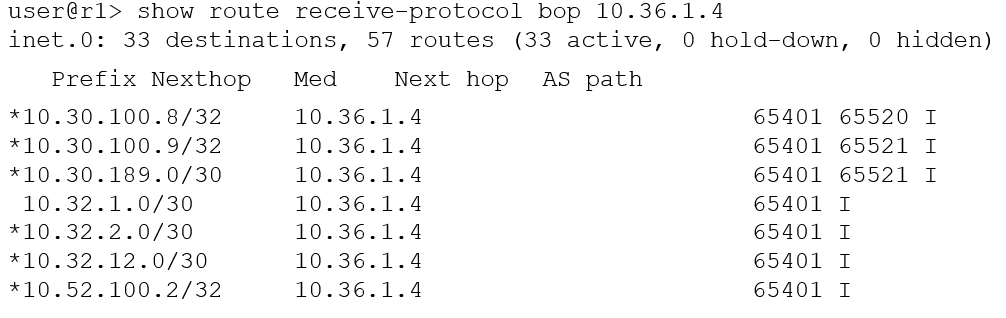
You want to verify prefix information being sent from 10.36.1.4.
Which two statements are correct about the output shown in the exhibit? (Choose two.)
- A. The routes displayed have traversed one or more autonomous systems.
- B. The output shows routes that were received prior to the application of any BGP import policies.
- C. The output shows routes that are active and rejected by an import policy.
- D. The routes displayed are being learned from an IBGP peer.
Correct Answer:
AB
Explanation:
The AI agrees with the suggested answer of AB.
Here's a detailed breakdown of why:
- A. The routes displayed have traversed one or more autonomous systems.
- Reasoning: The exhibit shows an AS path (e.g., "{65170,65001} 1239"). This indicates that the routes have indeed traversed at least one autonomous system. The presence of multiple AS numbers within the AS path confirms this.
- B. The output shows routes that were received prior to the application of any BGP import policies.
- Reasoning: The command `show route receive-protocol bgp` displays the routes *before* any import policies are applied. This is crucial for troubleshooting and understanding the raw BGP updates received from a neighbor. Juniper documentation confirms this function.
- C. The output shows routes that are active and rejected by an import policy.
- Reasoning: The `show route receive-protocol bgp` command does *not* indicate the active status of a route, nor does it explicitly state whether a route was rejected by an import policy. It only shows the routes received. To see the active routes, you would use `show route`. To diagnose policy rejections, you'd typically examine policy configuration and potentially use traceoptions. Therefore, this is incorrect.
- D. The routes displayed are being learned from an IBGP peer.
- Reasoning: The exhibit shows that the neighbor is 10.36.1.4. There is no inherent indication from the `show route receive-protocol bgp` output or the neighbor IP address itself that definitively classifies the peer as an IBGP (Internal BGP) peer. It is more likely an EBGP (External BGP) peer because it does not belong to the same AS as the router receiving the routes. The AS path indicates the routes are traversing different autonomous systems which points to an EBGP relationship. Therefore, this is likely incorrect.
In summary, the AI agrees that options A and B are the correct interpretations of the output from the `show route receive-protocol bgp` command.
-
Routes have traversed one or more autonomous systems based on the AS path attributes shown in the output.
-
The output is before any import policies are applied.
-
show route receive-protocol bgp command: https://www.juniper.net/documentation/us/en/software/junos/bgp/topics/topic-map/bgp-policy-understanding.html
-
Question 8
What is the default keepalive time for BGP?
- A. 10 seconds
- B. 60 seconds
- C. 30 seconds
- D. 90 seconds
Correct Answer:
C
Explanation:
The AI agrees with the suggested answer. The correct answer is C. 30 seconds.
Reasoning: The default BGP keepalive timer is 30 seconds, and the hold time is 90 seconds. Keepalive messages are sent every one-third of the hold time interval. Therefore, the default keepalive interval is 30 seconds (90/3 = 30).
Reasons for not choosing other options:
- A. 10 seconds: This is not the default keepalive time for BGP.
- B. 60 seconds: This is not the default keepalive time for BGP.
- D. 90 seconds: 90 seconds is the default hold time, not the keepalive time.
Citations:
- Understanding BGP timers, https://www.juniper.net/documentation/us/en/software/junos/bgp/topics/topic-map/bgp-timers.html
-
Question 9
Which two statements are correct about tunnels? (Choose two.)
- A. BFD cannot be used to monitor tunnels.
- B. Tunnel endpoints must have a valid route to the remote tunnel endpoint.
- C. IP-IP tunnels are stateful.
- D. Tunnels add additional overhead to packet size.
Correct Answer:
BD
Explanation:
The AI assistant agrees with the suggested answer of BD.
Option B is correct because tunnel endpoints must indeed have a valid route to the remote tunnel endpoint for the tunnel to function correctly. Without a route, the encapsulated packets cannot reach their destination.
Option D is also correct. Tunnels, by their nature, add additional header information to the original packet (encapsulation). This additional header increases the overall packet size, which represents an overhead.
Option A is incorrect. BFD (Bidirectional Forwarding Detection) can be used to monitor tunnels. BFD provides a low-overhead mechanism for detecting failures in the path between two forwarding engines, including paths through tunnels.
Option C is incorrect. IP-IP tunnels are generally considered stateless. Each packet is forwarded based on the encapsulation header, without maintaining any session state information.
Reasoning:
The conclusion of the answer to this question is BD, because:
- Option B is correct because for a tunnel to function, each endpoint must have a valid route to the other endpoint.
- Option D is correct as tunnels encapsulate packets, adding header information, thus increasing packet size and overhead.
Supporting Citations:
-
Question 10
Which statement is correct about IP-IP tunnels?
- A. IP-IP tunnels only support encapsulating IP traffic.
- B. IP-IP tunnels only support encapsulating non-IP traffic.
- C. The TTL in the inner packet is decremented during transit to the tunnel endpoint.
- D. There are 24 bytes of overhead with IP-IP encapsulation.
Correct Answer:
A
Explanation:
Based on the question and discussion, the AI agrees with the suggested answer A.
The reasoning is as follows:
IP-IP tunnels are specifically designed to encapsulate IP traffic. This is their primary function. The discussion correctly points out that options C and D are incorrect.
Here's a breakdown of why the other options are incorrect:
- Option B is incorrect because IP-IP tunnels are designed to encapsulate IP traffic, not non-IP traffic.
- Option C is incorrect because the TTL of the inner packet is not decremented during transit through the IP-IP tunnel. The outer IP header's TTL is decremented.
- Option D is incorrect because the overhead introduced by IP-IP encapsulation is 20 bytes for IPv4 and 40 bytes for IPv6, not 24 bytes.
Therefore,
option A is the most accurate answer.
Citations:
- IP Tunneling, https://www.juniper.net/documentation/us/en/software/junos/network-interfaces/topics/topic-map/ip-tunneling.html
About This Practice Material
This is independent study material to help you prepare for the Juniper Routing & Switching (JNCIS-ENT, JN0-351) exam. It is not affiliated with, endorsed by, or sponsored by Juniper or any certification body. All product names, certification names, trademarks, and exam codes are the property of their respective owners and are used here for descriptive (nominative) purposes only.
We do not provide real exam questions, brain dumps, or any guarantee of passing. All questions are original practice items compiled from publicly available community discussions and AI-generated explanations, aligned to the publicly available exam objectives.