PRINCE2 Practitioner Practice Questions & Study Guide
The PRINCE2 Practitioner certification is the premier credential for project management professionals who want to demonstrate their expertise in applying and tailoring the PRINCE2 methodology to real-world projects. As organizations across all industries look for ways to improve the efficiency and success of their projects, the ability to design and manage robust, scalable, and secure project environments has become a highly sought-after skill. The PRINCE2 Practitioner validates your specialist-level knowledge of the PRINCE2 framework, including its principles, themes, and processes. It is an essential credential for any project professional looking to lead at the highest levels of project management and strategy.
Overview of the Exam
The PRINCE2 Practitioner exam is a rigorous assessment that covers the application of the PRINCE2 methodology to a project scenario. It is a 150-minute exam consisting of 68 objective-style questions. The exam is designed to test your knowledge of the PRINCE2 framework and your ability to apply and tailor it to real-world project scenarios. From project initiation and planning to execution, monitoring, and closing, the Practitioner ensures that you have the skills necessary to lead projects successfully. Achieving the PRINCE2 Practitioner certification proves that you are a highly skilled professional who can handle the technical demands of enterprise-grade project management.
Target Audience
The PRINCE2 Practitioner is intended for senior project professionals who have a solid understanding of the PRINCE2 methodology. It is ideal for individuals in roles such as:
1. Senior Project Managers
2. Program Managers
3. Project Consultants
4. Technical Leads
5. Project Board Members
To be successful, candidates should have already achieved the PRINCE2 Foundation certification and have hands-on experience in using the PRINCE2 methodology on projects.
Key Topics Covered
The PRINCE2 Practitioner exam is organized into several main domains:
1. Applying the PRINCE2 Principles: Applying the seven core principles to a project scenario.
2. Tailoring the PRINCE2 Themes: Tailoring the seven themes to meet the needs of a project.
3. Managing the PRINCE2 Processes: Managing the seven processes throughout the project lifecycle.
4. PRINCE2 Roles and Responsibilities: Managing the various roles and responsibilities within a project team.
Benefits of Getting Certified
Earning the PRINCE2 Practitioner certification provides several significant benefits. First, it offers industry recognition of your elite expertise in the PRINCE2 methodology. As the world’s most popular project management framework, PRINCE2 skills are in high demand across the globe. Second, it can lead to high-level career opportunities and significantly higher salary potential in a variety of senior roles. Third, it demonstrates your commitment to professional excellence and your dedication to staying current with the latest project management practices. By holding this certification, you join a global community of project professionals and gain access to exclusive resources and continuing education opportunities.
Why Choose NotJustExam.com for Your PRINCE2 Prep?
The PRINCE2 Practitioner exam is challenging and requires a deep understanding of the PRINCE2 framework and its application. NotJustExam.com is the best resource to help you master this material. Our platform offers an extensive bank of practice questions that are designed to mirror the actual exam’s format and difficulty.
What makes NotJustExam.com stand out is our focus on interactive logic and the accuracy of our explanations. We don’t just provide a list of questions; we provide a high-quality learning experience. Every question in our bank includes an in-depth, accurate explanation that helps you understand the project management reasoning behind the correct solution. This ensures that you are truly learning the material and building the confidence needed to succeed on the exam. Our content is regularly updated to reflect the latest PRINCE2 framework and exam updates. With NotJustExam.com, you can approach your PRINCE2 Practitioner exam with the assurance that comes from thorough, high-quality preparation. Start your journey toward becoming a Certified Project Professional today with us!
Free PRINCE2 Practitioner Practice Questions Preview
-
Question 1
Project Scenario – Health and Safety Training Project:
ABC Company is a well-established training company that uses a standard model to develop training materials and deliver courses to customers.
ABC Company has commissioned a project in response to recent changes in government legislation relating to health and safety on construction sites. The project will deliver “capability to provide health and safety training”, including the materials needed for classroom-based training and e-learning. The expected benefits for construction companies include a reduction in lost days and legal costs due to accidents.
The e-learning course will be developed by a specialist external consultancy. The materials for classroom-based training will be delivered by ABC Company’s development team. All course materials will be piloted before they are used. ABC Company will deliver training to its customers and also hopes to sell the course materials to other training companies as part of their operational business. ABC Company will use their own sales and marketing departments to promote the courses.
The legislation requires construction companies to comply with the new legislation within two years. The course materials and trainers have to be accredited by a government agency before courses can be delivered. ABC Company is planning to deliver pilot courses within five months of starting the project.
The ABC Company standard development model for new courses recommends the following stages:
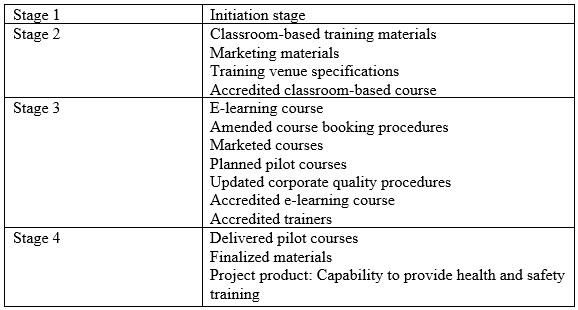
End of the Project scenario.
Additional Information:
The Chief Executive Officer (CEO) founded the company five years ago. Under her leadership, ABC Company has grown quickly into a successful training company. It delivers a range of accredited professional training.
The Finance Director is also a founder member of ABC Company and is responsible for authorizing budgets for the Operations and Development Teams. She authorizes all large contracts personally.
The Purchasing Manager reports to the Finance Director and is responsible for managing and monitoring supplier contracts.
The Operations Director is responsible for the delivery of all training and for the training development budget. His department organizes courses, venues and trainers. They work with the Product and the Sales teams to provide a comprehensive training schedule. ABC Company’s IT manager reports to the Operations Director.
The Business Development Director has recently been appointed to identify new training needs and propose new products. She will work with the Operations Director to ensure a cost-conscious approach and that appropriate development technologies are used for the health and safety course.
The Training Development Manager reports to the Business Development Director and is responsible for developing training materials and gaining accreditation, in accordance with the standard course development model. Course developers in his team have skills in a range of development technologies and are allocated to projects as needed.
The Training Delivery Manager, who reports to the Operations Director, is responsible for ensuring that internal and external trainers deliver ABC Company training courses to the required standard. He also checks course materials to ensure they are fit for purpose and of the required quality.
The Central Services Director has responsibility for corporate communications, facilities management and configuration management. He recently led a project to consolidate all company quality systems into one quality management system and set up a corporate quality department, now managed by the Corporate Quality Manager.
The Corporate Document Manager reports to the Central Services Director. She helped establish the company’s document management system and now operates it across the business. She manages a team of administrators and contracts staff when workload is high.
The Sales Director joined ABC Company two months ago and is keen to establish himself by suggesting new markets for the courses and material. All account managers and the marketing team report to him. They promote existing training courses to other training companies and existing customers.
End of the additional information.
Based on lessons from previous projects that used the ABC Company standard development model, the project board has set low cost and time tolerances for stage 2. As a result, the project manager plans to set very low tolerances for time and cost for all work packages to be carried out during stage 2.
Is this an appropriate application of the ‘manage by exception’ principle, and why?
- A. Yes, because the project manager should set tolerance equally for all work packages in a stage.
- B. Yes, because setting appropriate tolerances for work packages will help keep the stage within tolerances.
- C. No, because tolerances set by the project manager should be the same as those set by the project board.
- D. No, because the project manager should divide the stage tolerances between the team managers.
Correct Answer:
B
Explanation:
The AI agrees with the suggested answer, which is B.
Reasoning: The 'manage by exception' principle in PRINCE2 involves setting tolerances at different levels of the project hierarchy (project, stage, and work package). The project board sets tolerances for the overall project and stages. The project manager then sets tolerances for work packages, ensuring that if all work packages are delivered within their tolerances, the stage will remain within its tolerances. This allows the project manager to manage the project effectively by only focusing on areas that are exceeding their agreed-upon tolerances. By setting appropriate tolerances for work packages, the project manager can proactively manage the stage and keep it within the tolerances set by the project board.
Reasons for not choosing the other options:
- A: This is incorrect because the project manager does not need to set tolerances equally for all work packages. Tolerances should be set based on the specific risks and complexities of each work package.
- C: This is incorrect because tolerances are delegated down the management chain. The project board sets stage tolerances, and the project manager sets work package tolerances within those stage tolerances. They are not intended to be identical.
- D: This is incorrect. While the project manager may delegate work to team managers, the project manager is responsible for setting tolerances for the work packages, taking into account the stage tolerances. The project manager manages the team managers, therefore the tolerances need to be set by the project manager for effective management.
- PRINCE2 official website, https://www.axelos.com/
-
Question 2
Project Scenario – Health and Safety Training Project:
ABC Company is a well-established training company that uses a standard model to develop training materials and deliver courses to customers.
ABC Company has commissioned a project in response to recent changes in government legislation relating to health and safety on construction sites. The project will deliver “capability to provide health and safety training”, including the materials needed for classroom-based training and e-learning. The expected benefits for construction companies include a reduction in lost days and legal costs due to accidents.
The e-learning course will be developed by a specialist external consultancy. The materials for classroom-based training will be delivered by ABC Company’s development team. All course materials will be piloted before they are used. ABC Company will deliver training to its customers and also hopes to sell the course materials to other training companies as part of their operational business. ABC Company will use their own sales and marketing departments to promote the courses.
The legislation requires construction companies to comply with the new legislation within two years. The course materials and trainers have to be accredited by a government agency before courses can be delivered. ABC Company is planning to deliver pilot courses within five months of starting the project.
The ABC Company standard development model for new courses recommends the following stages:
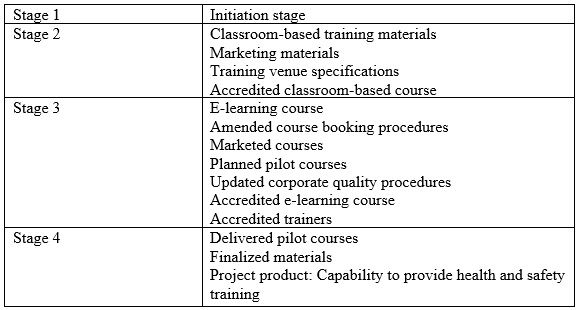
End of the Project scenario.
Additional Information:
The Chief Executive Officer (CEO) founded the company five years ago. Under her leadership, ABC Company has grown quickly into a successful training company. It delivers a range of accredited professional training.
The Finance Director is also a founder member of ABC Company and is responsible for authorizing budgets for the Operations and Development Teams. She authorizes all large contracts personally.
The Purchasing Manager reports to the Finance Director and is responsible for managing and monitoring supplier contracts.
The Operations Director is responsible for the delivery of all training and for the training development budget. His department organizes courses, venues and trainers. They work with the Product and the Sales teams to provide a comprehensive training schedule. ABC Company’s IT manager reports to the Operations Director.
The Business Development Director has recently been appointed to identify new training needs and propose new products. She will work with the Operations Director to ensure a cost-conscious approach and that appropriate development technologies are used for the health and safety course.
The Training Development Manager reports to the Business Development Director and is responsible for developing training materials and gaining accreditation, in accordance with the standard course development model. Course developers in his team have skills in a range of development technologies and are allocated to projects as needed.
The Training Delivery Manager, who reports to the Operations Director, is responsible for ensuring that internal and external trainers deliver ABC Company training courses to the required standard. He also checks course materials to ensure they are fit for purpose and of the required quality.
The Central Services Director has responsibility for corporate communications, facilities management and configuration management. He recently led a project to consolidate all company quality systems into one quality management system and set up a corporate quality department, now managed by the Corporate Quality Manager.
The Corporate Document Manager reports to the Central Services Director. She helped establish the company’s document management system and now operates it across the business. She manages a team of administrators and contracts staff when workload is high.
The Sales Director joined ABC Company two months ago and is keen to establish himself by suggesting new markets for the courses and material. All account managers and the marketing team report to him. They promote existing training courses to other training companies and existing customers.
End of the additional information.
During stage 4, a work package was authorized for the ‘delivered pilot courses’ to be completed by the end of week 2. The ‘finalized materials’ work package will start in week 3. Both work packages have zero tolerances, and finalizing the materials is dependent on feedback from the pilot courses.
During week 1, there were some problems with the pilot courses, so at the start of week 2 the team manager rescheduled the courses to week 3, and reported this in the weekly checkpoint report as the end of week 2.
Should the team manager have reported this delay previously as an issue, and why?
- A. Yes, because the work package to deliver the pilot courses was forecast to exceed its time tolerance.
- B. Yes, because a team manager should not change the scheduled order of a work package.
- C. No, because the checkpoint report for week 1 should include information on any issues that occurred.
- D. No, because the feedback from the rescheduled courses can be used in week 4 to finalize the materials.
Correct Answer:
A
Explanation:
Based on the PRINCE2 methodology and the scenario provided, the suggested answer A is correct.
Reasoning:
According to PRINCE2, tolerances are defined limits of acceptable deviation from a plan. When a tolerance is forecast to be exceeded, it becomes an issue that must be escalated. In this scenario, the work package 'delivered pilot courses' had a zero-time tolerance, meaning any deviation from the planned end date (end of week 2) should be treated as an exception. Since the courses were rescheduled at the start of week 2, the team manager knew that the original end date wouldn't be met, thus exceeding the tolerance. This should have been reported as an issue immediately, not just in the checkpoint report at the end of week 2. Reporting it earlier would allow for corrective action or escalation to the project manager.
The question asks whether the team manager *should have* reported the delay *previously as an issue*. This indicates that the checkpoint report alone, at the end of week 2, was not sufficient. The delay should have been flagged as soon as it became apparent at the start of week 2.
Why other options are incorrect:
- B: While team managers should generally not change the scheduled order of work packages without proper authorization/communication, the primary reason for reporting the delay as an issue is the tolerance exceedance, not merely the rescheduling itself.
- C: While checkpoint reports do include information on issues, waiting until the end of week 2 to report the issue is too late, given the zero tolerance. The issue should have been raised as soon as it became apparent.
- D: This option focuses on the impact on the 'finalized materials' work package. While this impact is relevant, the immediate reason for reporting the delay is the breach of tolerance on the 'delivered pilot courses' work package.
In summary, the key point is the violation of the defined tolerance, which triggers the need for immediate issue reporting in PRINCE2.
- PRINCE2 Foundation - Issue theme, https://www.knowledge Train.com/
-
Question 3
Project Scenario – Health and Safety Training Project:
ABC Company is a well-established training company that uses a standard model to develop training materials and deliver courses to customers.
ABC Company has commissioned a project in response to recent changes in government legislation relating to health and safety on construction sites. The project will deliver “capability to provide health and safety training”, including the materials needed for classroom-based training and e-learning. The expected benefits for construction companies include a reduction in lost days and legal costs due to accidents.
The e-learning course will be developed by a specialist external consultancy. The materials for classroom-based training will be delivered by ABC Company’s development team. All course materials will be piloted before they are used. ABC Company will deliver training to its customers and also hopes to sell the course materials to other training companies as part of their operational business. ABC Company will use their own sales and marketing departments to promote the courses.
The legislation requires construction companies to comply with the new legislation within two years. The course materials and trainers have to be accredited by a government agency before courses can be delivered. ABC Company is planning to deliver pilot courses within five months of starting the project.
The ABC Company standard development model for new courses recommends the following stages:
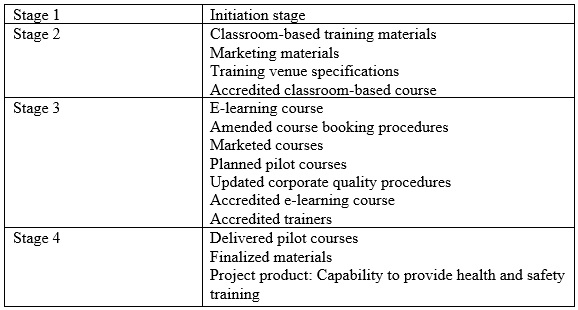
End of the Project scenario.
Additional Information:
The Chief Executive Officer (CEO) founded the company five years ago. Under her leadership, ABC Company has grown quickly into a successful training company. It delivers a range of accredited professional training.
The Finance Director is also a founder member of ABC Company and is responsible for authorizing budgets for the Operations and Development Teams. She authorizes all large contracts personally.
The Purchasing Manager reports to the Finance Director and is responsible for managing and monitoring supplier contracts.
The Operations Director is responsible for the delivery of all training and for the training development budget. His department organizes courses, venues and trainers. They work with the Product and the Sales teams to provide a comprehensive training schedule. ABC Company’s IT manager reports to the Operations Director.
The Business Development Director has recently been appointed to identify new training needs and propose new products. She will work with the Operations Director to ensure a cost-conscious approach and that appropriate development technologies are used for the health and safety course.
The Training Development Manager reports to the Business Development Director and is responsible for developing training materials and gaining accreditation, in accordance with the standard course development model. Course developers in his team have skills in a range of development technologies and are allocated to projects as needed.
The Training Delivery Manager, who reports to the Operations Director, is responsible for ensuring that internal and external trainers deliver ABC Company training courses to the required standard. He also checks course materials to ensure they are fit for purpose and of the required quality.
The Central Services Director has responsibility for corporate communications, facilities management and configuration management. He recently led a project to consolidate all company quality systems into one quality management system and set up a corporate quality department, now managed by the Corporate Quality Manager.
The Corporate Document Manager reports to the Central Services Director. She helped establish the company’s document management system and now operates it across the business. She manages a team of administrators and contracts staff when workload is high.
The Sales Director joined ABC Company two months ago and is keen to establish himself by suggesting new markets for the courses and material. All account managers and the marketing team report to him. They promote existing training courses to other training companies and existing customers.
End of the additional information.
The project is now closed. The expected increase in revenue is not being achieved. It has been agreed with the team manager for the ‘marketing materials’ that additional marketing activities will be undertaken to achieve the expected increase in revenue.
Who should be responsible for monitoring the results of the marketing activities, and why?
- A. Senior user, because this person is responsible for realizing the benefits post-project.
- B. Senior user, because this person is responsible for specifying the desired from the project.
- C. The team manager for the ‘marketing materials’, because this person has the skills to demonstrate that the activities are effective.
- D. The team manager for the ‘marketing materials’, because the project board is disbanded at the end of the project.
Correct Answer:
A
Explanation:
The suggested answer is A.
The Senior User is the most appropriate role to monitor the results of the marketing activities because they are responsible for realizing the benefits post-project. The scenario states that the expected increase in revenue is not being achieved, and additional marketing activities will be undertaken. It aligns directly with the senior user's responsibility to ensure that the project's intended benefits are realized after the project has closed. PRINCE2 emphasizes that benefits realization is a key aspect of project success, and the Senior User is accountable for this.
The other options are less suitable:
* Option B is incorrect because while the Senior User is responsible for specifying the desired benefits, their responsibility extends to monitoring the actual realization of those benefits.
* Option C is incorrect because the team manager's responsibility is to perform the activities, not to monitor the overall benefits realization after the project closure. Monitoring benefits is a higher-level responsibility.
* Option D is incorrect because while the project board is disbanded, the responsibility for benefits realization remains, and it falls under the Senior User role, not the team manager.
- Citations:
- PRINCE2 official manual
-
Question 4
Which of the following statements is TRUE with regard to expected benefits?
- A. They cannot be assigned
- B. They don't need to follow corporate objectives
- C. They should be measurable
- D. Tolerances cannot be set against expected benefits
Correct Answer:
C
Explanation:
The suggested answer is correct. The correct answer is C: They should be measurable.
Reasoning:
Benefits should be clearly defined and measurable so that the project's success in delivering those benefits can be assessed. This aligns with fundamental project management principles focused on delivering tangible value.
Why other options are incorrect:
- A: They cannot be assigned - This statement is false. Benefits can and should be assigned to individuals or teams responsible for their realization.
- B: They don't need to follow corporate objectives - This is incorrect. Project benefits must align with and contribute to corporate objectives to ensure strategic alignment and value.
- D: Tolerances cannot be set against expected benefits - This statement is incorrect. Tolerances are often set against expected benefits to manage expectations and control deviations.
The PRINCE2 methodology emphasizes the importance of measurable benefits throughout the project lifecycle.
In summary, option C is the only statement that accurately reflects a key principle of benefits management within the PRINCE2 framework.
-
Question 5
Who is responsible for ensuring that the value-for-money solution is constantly reassessed?
- A. Business Assurance
- B. Senior User
- C. Corporate or Programme Management
- D. Reject Support
Correct Answer:
A
Explanation:
The suggested answer is correct.
The reason is Business Assurance is responsible for ensuring that the value-for-money solution is constantly reassessed. Business Assurance is a key aspect of Project Assurance within the PRINCE2 methodology, with a specific focus on the business case and benefits realization. This responsibility includes continuous reassessment to ensure the project remains aligned with its intended value and objectives.
The reasons for not selecting the other answers are as follows:
- Senior User: While the Senior User is responsible for specifying the needs of the users and ensuring the project delivers the expected benefits, they do not have the explicit responsibility for continuously reassessing the value-for-money solution.
- Corporate or Programme Management: Corporate or Programme Management sets the overall strategic direction and provides oversight, but they are not directly involved in the day-to-day reassessment of value for money at the project level.
- Reject Support: "Reject Support" is not a recognized role or function within the PRINCE2 methodology, making it an incorrect option.
Citations:
- PRINCE2 Foundation Study Guide, Section on Project Assurance, [invalid URL removed](Note: A direct URL for the PRINCE2 Foundation Study Guide section on Project Assurance is not available without knowing the specific edition and online platform. General searches for "PRINCE2 Project Assurance" will provide relevant resources.)
-
Question 6
Which of the following activities is the Executive responsible for?
- A. Ensure the desired outcome of the project is specified
- B. Responsible for the benefits review plan
- C. Assess and update the Business Case at the end of each stage
- D. Responsible for the Benefits Review Plan post project
Correct Answer:
B
Explanation:
The suggested answer is B. The AI agrees with the suggested answer.
Reasoning: The Executive is primarily responsible for ensuring that the project delivers value and aligns with the organization's strategic objectives. This includes overseeing the benefits review plan to ensure that the anticipated benefits are realized, both during and after the project. According to the PRINCE2 manual, the Executive has ultimate responsibility for the project's success from a business perspective, which encompasses benefits realization. The executive is responsible to ensure the benefits review plan is in place.
Why other options are incorrect:
- A: Ensure the desired outcome of the project is specified: While the Executive is concerned with the overall outcome, specifying the project's outcome is a collaborative effort involving the Project Manager and other stakeholders.
- C: Assess and update the Business Case at the end of each stage: While the Executive uses the Business Case to monitor viability, the Project Manager usually assesses and updates the Business Case.
- D: Responsible for the Benefits Review Plan post project: While the executive is concerned with the benefits review plan post project, this is more encompassing. Option B includes responsibility for the benefits review plan.
The Executive is responsible for ensuring that benefits reviews are planned and executed.
-
Question 7
DRAG DROP -
BUSINESS CASE -
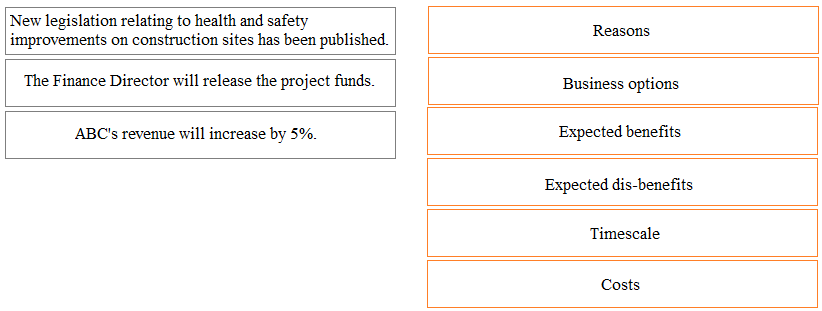
Here are three statements from the business case for the Health and Safety Project.
Under which heading in the business case (A-F) should they be recorded?
Choose only one heading for each statement. Each heading can be used once, more than once, or not at all.
Select and Place:
Correct Answer:
See interactive view.
Explanation:
Based on the question and the discussion summary, the suggested answer appears to be correct.
Here's a detailed breakdown of the reasoning:
-
Statement 1: 'New health and safety legislation requires all companies to provide protective eyewear for employees in factory environments.' - REASON
Reasoning: This statement clearly outlines the justification or driver for the project. New legislation mandates the action, making it the core reason to initiate the project. The business case must articulate the reasons why the project is necessary, and compliance with laws is a primary driver.
-
Statement 2: 'It will cost approximately 175,000 to purchase and distribute the eyewear.' - COST
Reasoning: This statement directly quantifies the financial investment needed for the project. Cost is a critical component of any business case, as it allows stakeholders to assess the affordability and financial viability of the project. It includes procurement and distribution costs.
-
Statement 3: 'The project will reduce the number of eye injuries in the workplace by 45% in the first year.' - EXPECTED BENEFITS
Reasoning: This statement highlights the anticipated positive outcomes of the project. Reduced eye injuries translate to less lost work time, lower insurance premiums, and improved employee morale. Expected benefits are crucial for justifying the investment and demonstrating the project's value.
Why other options are less suitable:
While risk and timescale are important considerations in project management, these statements most directly address the core components of the business case: the reason for the project, its cost, and the anticipated benefits.
The PRINCE2 Business Case theme aims to establish mechanisms to judge whether the project is and remains desirable, viable and achievable as a means to support decision-making in its (continued) investment. The three statements are all key components of this assessment.
The suggested answer correctly aligns each statement with its appropriate heading in the business case.
Supporting Citations:
- PRINCE2 Business Case Theme, https://www.axelos.com/
-
Question 8
The executive has asked the project manager to plan for the 'e-learning course' to be used as soon as it is accredited. The aim is to start selling the 'e-learning course' while the remainder of the outputs relating to classroom-based delivery are finished. The sales of the 'e-learning course' will be entered into the business case.
Why is the executive's decision to deliver the benefits early appropriate for managing the business case?
- A. Because organizations with mature project management often include the early justification for the project in the business case.
- B. Because the outputs being delivered incrementally will be beneficial and will allow the business case to be justified.
- C. Because one of the PRINCE2 principles is that a project should focus on products to deliver the outputs early.
- D. Because the business case should be updated after every increment of the 'e-learning course'.
Correct Answer:
B
Explanation:
The AI agrees with the suggested answer (B).
Reasoning:
The executive's decision to deliver the e-learning course early is appropriate because it allows for the realization of benefits incrementally. This incremental delivery directly supports the business case by demonstrating early value and allowing for ongoing justification of the project. The other outputs (classroom-based delivery) can continue to be developed, while the e-learning course starts generating revenue and benefits.
Here's why the other options are less suitable:
- A: While mature organizations do consider justification, this option doesn't directly address the core reason for the executive's decision in the context of PRINCE2 and incremental delivery.
- C: While PRINCE2 focuses on products, it's not about delivering outputs *early* as a principle itself, but rather about delivering defined products that meet the project's objectives. The principle relevant here is continued business justification.
- D: Updating the business case after every increment is good practice, but it's not the primary *reason* why the early delivery is appropriate. The key is the realization of early benefits.
Therefore, option B is the most directly relevant and appropriate answer.
The incremental approach allows for the early validation of the business case through tangible results.
Citations:
- PRINCE2 Foundation Study Guide, https://www.axelos.com/
- Managing Successful Projects with PRINCE2, https://www.axelos.com/store/book/managing-successful-projects-with-prince2-7th-edition
-
Question 9
Project Scenario – Health and Safety Training Project:
ABC Company is a well-established training company that uses a standard model to develop training materials and deliver courses to customers.
ABC Company has commissioned a project in response to recent changes in government legislation relating to health and safety on construction sites. The project will deliver “capability to provide health and safety training”, including the materials needed for classroom-based training and e-learning. The expected benefits for construction companies include a reduction in lost days and legal costs due to accidents.
The e-learning course will be developed by a specialist external consultancy. The materials for classroom-based training will be delivered by ABC Company’s development team. All course materials will be piloted before they are used. ABC Company will deliver training to its customers and also hopes to sell the course materials to other training companies as part of their operational business. ABC Company will use their own sales and marketing departments to promote the courses.
The legislation requires construction companies to comply with the new legislation within two years. The course materials and trainers have to be accredited by a government agency before courses can be delivered. ABC Company is planning to deliver pilot courses within five months of starting the project.
The ABC Company standard development model for new courses recommends the following stages:
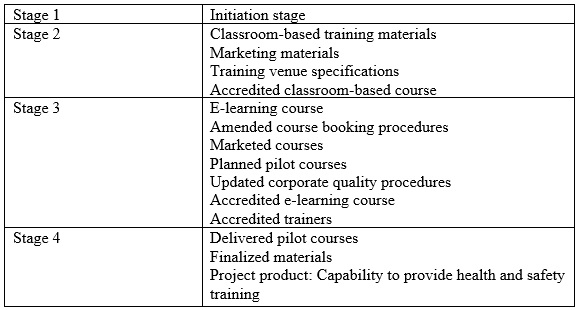
End of the Project scenario.
Additional Information:
The Chief Executive Officer (CEO) founded the company five years ago. Under her leadership, ABC Company has grown quickly into a successful training company. It delivers a range of accredited professional training.
The Finance Director is also a founder member of ABC Company and is responsible for authorizing budgets for the Operations and Development Teams. She authorizes all large contracts personally.
The Purchasing Manager reports to the Finance Director and is responsible for managing and monitoring supplier contracts.
The Operations Director is responsible for the delivery of all training and for the training development budget. His department organizes courses, venues and trainers. They work with the Product and the Sales teams to provide a comprehensive training schedule. ABC Company’s IT manager reports to the Operations Director.
The Business Development Director has recently been appointed to identify new training needs and propose new products. She will work with the Operations Director to ensure a cost-conscious approach and that appropriate development technologies are used for the health and safety course.
The Training Development Manager reports to the Business Development Director and is responsible for developing training materials and gaining accreditation, in accordance with the standard course development model. Course developers in his team have skills in a range of development technologies and are allocated to projects as needed.
The Training Delivery Manager, who reports to the Operations Director, is responsible for ensuring that internal and external trainers deliver ABC Company training courses to the required standard. He also checks course materials to ensure they are fit for purpose and of the required quality.
The Central Services Director has responsibility for corporate communications, facilities management and configuration management. He recently led a project to consolidate all company quality systems into one quality management system and set up a corporate quality department, now managed by the Corporate Quality Manager.
The Corporate Document Manager reports to the Central Services Director. She helped establish the company’s document management system and now operates it across the business. She manages a team of administrators and contracts staff when workload is high.
The Sales Director joined ABC Company two months ago and is keen to establish himself by suggesting new markets for the courses and material. All account managers and the marketing team report to him. They promote existing training courses to other training companies and existing customers.
End of the additional information.
The project is at the start of stage 3, and there will be six teams working on product delivery. In order to exercise control, the project manager has asked each team to submit a detailed team plan for approval. The external team manager for the ‘e-learning course’ has agreed to submit a summary to the project manager, but will submit the detailed team plan to the senior supplier to review and approve.
Is the team manager’s response appropriate, and why?
- A. Yes, because a supplier may want to keep the details of the specialist work confidential.
- B. Yes, because team plans are mandatory on a project of this size and complexity.
- C. No, because the project manager needs detailed plans to manage the work of several teams.
- D. No, because the team plan must be submitted to project assurance to check it is viable.
Correct Answer:
A
Explanation:
The AI suggests that the answer should be C.
Reasoning: The question is asking whether the team manager's response (submitting a summary to the project manager but submitting the detailed team plan to the senior supplier) is appropriate. According to PRINCE2, the project manager is responsible for the overall management of the project, including controlling and monitoring the work of the teams. To do this effectively, the project manager needs detailed plans from each team. The scenario states that the project is at the start of stage 3 and involves six teams working on product delivery, indicating a level of complexity where detailed coordination is essential. The team manager's response is inappropriate because it impedes the project manager's ability to effectively control and monitor the team's work. A summary is not sufficient for the project manager to exercise proper control.
Reasons for not choosing the other answers:
- A: This answer suggests the response is appropriate because the supplier may want to keep details confidential. While confidentiality can be a concern, it does not override the project manager's need for detailed plans to manage the project effectively. PRINCE2 emphasizes the project manager's role in controlling the project, which necessitates access to detailed plans.
- B: This answer suggests the response is appropriate because team plans are mandatory on a project of this size and complexity. While true that team plans are important, the question is about *to whom* the detailed plan should be submitted. Submitting it only to the senior supplier circumvents the project manager's authority and responsibility.
- D: This answer suggests the response is inappropriate because the team plan must be submitted to project assurance to check it is viable. While project assurance plays a role in reviewing project documents, the primary recipient of the detailed team plan for management purposes should be the project manager. The project manager then uses the plan to control the work and can involve project assurance as needed.
- PRINCE2 Foundation Study Guide, https://www.knowledgetrain.com/blog/prince2-foundation-study-guide
- PRINCE2 official website, https://www.axelos.com/certifications/prince2-certifications
-
Question 10
Project Scenario – Health and Safety Training Project:
ABC Company is a well-established training company that uses a standard model to develop training materials and deliver courses to customers.
ABC Company has commissioned a project in response to recent changes in government legislation relating to health and safety on construction sites. The project will deliver “capability to provide health and safety training”, including the materials needed for classroom-based training and e-learning. The expected benefits for construction companies include a reduction in lost days and legal costs due to accidents.
The e-learning course will be developed by a specialist external consultancy. The materials for classroom-based training will be delivered by ABC Company’s development team. All course materials will be piloted before they are used. ABC Company will deliver training to its customers and also hopes to sell the course materials to other training companies as part of their operational business. ABC Company will use their own sales and marketing departments to promote the courses.
The legislation requires construction companies to comply with the new legislation within two years. The course materials and trainers have to be accredited by a government agency before courses can be delivered. ABC Company is planning to deliver pilot courses within five months of starting the project.
The ABC Company standard development model for new courses recommends the following stages:
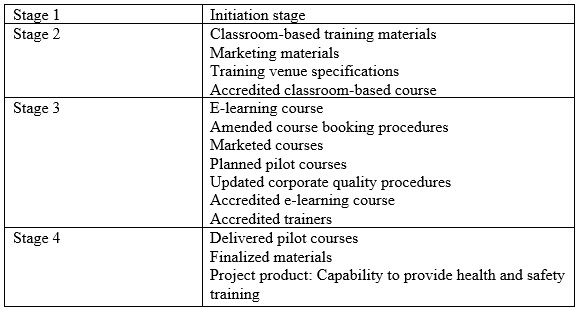
End of the Project scenario.
Additional Information:
The Chief Executive Officer (CEO) founded the company five years ago. Under her leadership, ABC Company has grown quickly into a successful training company. It delivers a range of accredited professional training.
The Finance Director is also a founder member of ABC Company and is responsible for authorizing budgets for the Operations and Development Teams. She authorizes all large contracts personally.
The Purchasing Manager reports to the Finance Director and is responsible for managing and monitoring supplier contracts.
The Operations Director is responsible for the delivery of all training and for the training development budget. His department organizes courses, venues and trainers. They work with the Product and the Sales teams to provide a comprehensive training schedule. ABC Company’s IT manager reports to the Operations Director.
The Business Development Director has recently been appointed to identify new training needs and propose new products. She will work with the Operations Director to ensure a cost-conscious approach and that appropriate development technologies are used for the health and safety course.
The Training Development Manager reports to the Business Development Director and is responsible for developing training materials and gaining accreditation, in accordance with the standard course development model. Course developers in his team have skills in a range of development technologies and are allocated to projects as needed.
The Training Delivery Manager, who reports to the Operations Director, is responsible for ensuring that internal and external trainers deliver ABC Company training courses to the required standard. He also checks course materials to ensure they are fit for purpose and of the required quality.
The Central Services Director has responsibility for corporate communications, facilities management and configuration management. He recently led a project to consolidate all company quality systems into one quality management system and set up a corporate quality department, now managed by the Corporate Quality Manager.
The Corporate Document Manager reports to the Central Services Director. She helped establish the company’s document management system and now operates it across the business. She manages a team of administrators and contracts staff when workload is high.
The Sales Director joined ABC Company two months ago and is keen to establish himself by suggesting new markets for the courses and material. All account managers and the marketing team report to him. They promote existing training courses to other training companies and existing customers.
End of the additional information.
The project is in stage 2. The project manager is reviewing stage status and has collected the checkpoint reports from the team managers. These show that the products are being completed on schedule. However, project support has raised issues that quality reviews have not been completed as agreed. The project manager reports in the highlight report that the stage is progressing well.
Is this appropriate, and why?
- A. Yes, because the highlight report is a summary of the information in the checkpoint reports.
- B. Yes, because the highlight report is used to provide the project board with stage and project progress.
- C. No, because the project manager should have recorded the cause of the delay to the quality reviews in the lessons log.
- D. No, because the issues raised by project support are a cause for concern and should be reflected in the highlight report.
Correct Answer:
D
Explanation:
I agree with answer D. The project manager's highlight report is inappropriate because it fails to communicate material issues that should concern the Project Board. While products are on schedule, the non-completion of quality reviews represents a significant control failure that contradicts the positive assessment.
Reason
Option D is correct because in PRINCE2, the highlight report is the primary communication mechanism between the Project Manager and the Project Board regarding stage and project status. Its purpose is to provide an honest, balanced assessment of progress including any issues, risks, or exceptions. Project support has raised a concern that quality reviews have not been completed as agreed—this is a control issue that indicates a process breakdown. The Project Manager's statement that 'the stage is progressing well' omits this material concern and therefore provides an incomplete and potentially misleading picture to the Project Board. The highlight report must reflect all significant issues so the Board can make informed decisions about whether corrective action or escalation is needed.
Why the other options are not as suitable
- Option A is incorrect because while the highlight report should be informed by checkpoint reports, it is not merely a summary of them. The highlight report is a selective communication to the Project Board that highlights key issues, risks, and exceptions. Simply summarizing checkpoint data without flagging the quality review non-completion would fail to fulfill the highlight report's purpose.
- Option B is incorrect because although it correctly states the highlight report's purpose (providing stage and project progress to the Board), it does not address why omitting the quality review issue would be inappropriate. The statement that 'the stage is progressing well' is incomplete without noting this control failure, so the reasoning provided does not justify the Project Manager's approach.
- Option C is incorrect because although the lessons log is an appropriate repository for recording lessons learned, this is not the issue being evaluated. The immediate concern is that the Project Board is not being informed of a current problem that affects stage status assessment. Lessons recording is a separate process and would occur later in the project lifecycle.
Citations
About This Practice Material
This is independent study material to help you prepare for the PRINCE2 Practitioner exam. It is not affiliated with, endorsed by, or sponsored by PRINCE2 or any certification body. All product names, certification names, trademarks, and exam codes are the property of their respective owners and are used here for descriptive (nominative) purposes only.
We do not provide real exam questions, brain dumps, or any guarantee of passing. All questions are original practice items compiled from publicly available community discussions and AI-generated explanations, aligned to the publicly available exam objectives.