 NotJustExam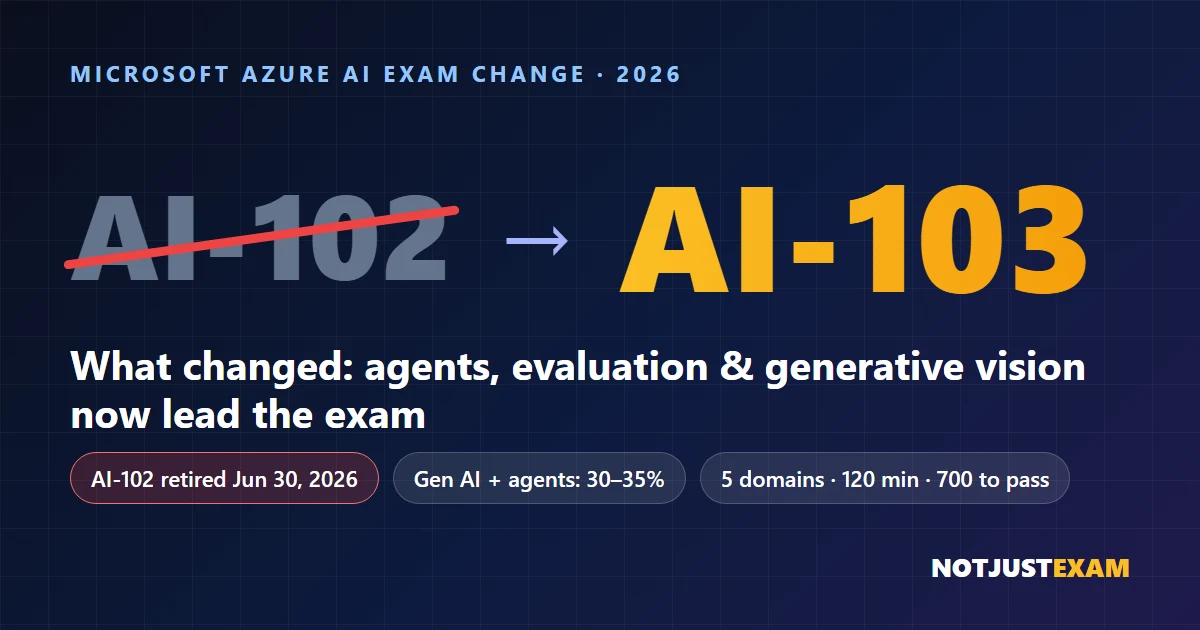
Microsoft retired Exam AI-102 on June 30, 2026, and replaced it with Exam AI-103: Developing AI Apps and Agents on Azure. Passing AI-103 earns the new Microsoft Certified: Azure AI Apps and Agents Developer Associate credential. The new exam keeps the familiar foundations — planning Azure AI solutions, retrieval-augmented generation (RAG), vision, language and document extraction — but moves the weight decisively toward generative AI and AI agents built with Microsoft Foundry, which now make up the largest domain at 30–35% of the exam.
This guide compares the two exams domain by domain, using Microsoft's own study guides, so you know exactly what carries over from AI-102 and what you need to learn fresh.
Key facts at a glance
- Exam
- AI-103: Developing AI Apps and Agents on Azure
- Credential
- Microsoft Certified: Azure AI Apps and Agents Developer Associate (intermediate)
- Replaces
- AI-102 (Microsoft Certified: Azure AI Engineer Associate), retired June 30, 2026, 11:59 PM CST
- Skills measured
- Version as of April 16, 2026 — 5 functional groups
- Biggest domain
- Implement generative AI and agentic solutions (30–35%)
- Duration
- 120 minutes, proctored; may include interactive components
- Passing score
- 700 or greater
- Programming language
- Python (AI-102's profile named Python and C#)
- Languages
- English, Chinese (Simplified), Chinese (Traditional), French, German, Japanese, Korean, Italian, Portuguese (Brazil), Spanish
- Official practice
- Free Practice Assessment on Microsoft AI Skills Navigator
Timeline: from AI-102 to AI-103
How the skill domains changed
AI-102 had six functional groups; AI-103 has five. Generative AI and agents — two separate, smaller domains on AI-102 — are merged into one domain that is now the heaviest on the exam. Planning and managing solutions also gained weight, while language and knowledge-mining topics were slimmed down.
| AI-102 domain (retired) | Weight | AI-103 domain | Weight | Change |
|---|---|---|---|---|
| Plan and manage an Azure AI solution | 20–25% | Plan and manage an Azure AI solution | 25–30% | ▲ +5 pts |
| Implement generative AI solutions + Implement an agentic solution | 15–20% + 5–10% | Implement generative AI and agentic solutions | 30–35% | ▲ merged, +5–10 pts |
| Implement computer vision solutions | 10–15% | Implement computer vision solutions | 10–15% | Same weight, new focus |
| Implement natural language processing solutions | 15–20% | Implement text analysis solutions | 10–15% | ▼ −5 pts |
| Implement knowledge mining and information extraction solutions | 15–20% | Implement information extraction solutions | 10–15% | ▼ −5 pts |
What's new in AI-103
Comparing the two study guides line by line, these skills appear in AI-103 but were absent or only implied in AI-102:
- Agents as a core skill, not a 5–10% add-on. Defining agent roles, goals and tool schemas; agents that combine retrieval, function calling and conversation memory; orchestrated multi-agent solutions; autonomous or semiautonomous workflows with safeguards and approval flows; and monitoring and error analysis for deployed agents.
- Governance of agent behavior. Oversight modes, constraints and tool-access controls, plus auditing through trace logging, provenance metadata and approval workflows.
- Evaluation and observability. Evaluating apps for fabrications, relevance, quality and safety; tracing, token analytics, safety signals and latency breakdowns; chain-of-thought evaluations and self-critique loops.
- Operating AI at scale. Managing quotas, scaling, rate limits and cost footprints for model and agent workloads, and monitoring drift, grounding quality and search index health.
- Keyless, private security. Managed identity, private networking, keyless credentials and role policies (AI-102 still listed managing and protecting account keys).
- Generative vision. Generating images and videos from text prompts and reference media, inpainting and mask-based edits, video editing workflows, and multimodal question answering grounded in visual evidence.
- Multimodal safety. Detecting indirect prompt injection hidden in text embedded in images, and enforcing visual policy rules such as watermarks and brand usage.
- Speech for agents. Speech as an agent modality, multimodal reasoning from audio inputs and speech translation with language models.
- Azure Content Understanding runs through vision, document extraction and RAG ingestion — including single-task and pro-mode pipelines and analyzers that output structured or markdown results.
What's no longer listed
These AI-102 skills do not appear in the AI-103 skills outline. Related topics can still show up — Microsoft notes that the bullets illustrate rather than limit the exam — but they are no longer named objectives:
Classic model-building
- Training, evaluating and publishing custom image classification and object-detection models
- Building language understanding models with intents, entities and utterances
- Custom question answering knowledge bases (multi-turn, chit-chat, export)
- Fine-tuning a generative model as a listed skill
Older services and deployment
- Azure AI Video Indexer and Spatial Analysis
- Container deployment of AI services, including edge devices
- Knowledge Store projections in Azure AI Search
- C# — AI-103's audience profile names Python only
In short: AI-102 tested whether you could pick and configure the right Azure AI service. AI-103 tests whether you can build, evaluate, secure and operate generative AI apps and agents end to end in Microsoft Foundry.
Already certified on AI-102?
If you earned the Azure AI Engineer Associate certification, it stays on the transcript in your Microsoft Learn profile. However, Microsoft has retired both the certification and its renewal assessment, so it can no longer be renewed. To hold a current Microsoft AI engineer credential, you need to pass AI-103 and earn the Azure AI Apps and Agents Developer Associate. Your AI-102 knowledge is a strong head start: RAG, semantic and vector search, content safety, OCR, translation and speech-to-text all carry over. Focus your study time on agents, evaluation, observability and generative vision.
AI-103 readiness checklist
Tick what you can already do — your progress is saved in this browser
0 of 15 ready
Gaps found? Test yourself on exam-style AI-103 questions in our free 10-question preview — it includes a mini practice exam.
How to prepare for AI-103
- Start with the official study guide and its skills outline — it is the definitive list of what can be tested.
- Get hands-on in Microsoft Foundry. Build at least one RAG app and one agent with tools and memory; most of the new objectives are things you do, not definitions.
- Weight your time like the exam does. Roughly a third on generative AI and agents, a quarter on planning, securing and monitoring, and the rest across vision, text analysis and information extraction.
- Take Microsoft's free Practice Assessment on AI Skills Navigator to calibrate.
- Drill exam-style questions and review why each wrong option is wrong — especially for scenario and case-study questions, which reward careful reading of requirements.
🎯 Practice for AI-103
Our AI-103 question bank has 150 exam-style practice questions, each with the community discussion, an AI step-by-step explanation and cited sources — plus timed Practice Exam Mode, progress tracking and tabbed case studies.
Independent practice material: not affiliated with Microsoft, and not real exam questions.
FAQ
Is AI-102 retired?
Yes. Microsoft retired Exam AI-102 on June 30, 2026, at 11:59 PM Central Standard Time. It can no longer be taken.
What replaced AI-102?
Exam AI-103: Developing AI Apps and Agents on Azure, which earns the Microsoft Certified: Azure AI Apps and Agents Developer Associate credential.
Is my Azure AI Engineer Associate certification still valid?
It stays on your Microsoft Learn transcript, but the certification and its renewal assessment are retired, so it cannot be renewed. To hold a current credential, take AI-103.
How different is AI-103 from AI-102?
The biggest change is that generative AI and agents are merged into one domain worth 30–35%, up from 20–30% across two domains. Planning and managing gains weight (25–30%), while language and knowledge-mining topics shrink to 10–15% each and computer vision shifts toward image and video generation and multimodal understanding.
Is AI-103 Python-only?
Microsoft's audience profile for AI-103 asks for experience developing apps with Python. AI-102's profile named both Python and C#.
How long is the AI-103 exam and what score do I need?
You have 120 minutes, and you need a score of 700 or greater to pass. The exam is proctored and may include interactive components.
Sources
- Microsoft Learn — Study guide for Exam AI-103 (skills measured as of April 16, 2026)
- Microsoft Learn — Study guide for Exam AI-102 (skills measured as of December 23, 2025; retirement notice)
- Microsoft Learn — Azure AI Apps and Agents Developer Associate (duration, languages, practice assessment)
- Microsoft Learn — Exam and assessment lab retirement (what happens to earned certifications)
Last checked against Microsoft Learn on October 11, 2026. Exam details change — always confirm on the official pages before you book.