 NotJustExam
Introduction: Your Path to a California Real Estate License
If you want to sell homes in the Golden State, the California real estate exam is the gateway you have to pass. It is a 150-question, timed test administered by the California Department of Real Estate (DRE), and it stands between you and a license that can launch a flexible, high-upside career. The good news: thousands of people pass it every month, and with the right preparation, you can be one of them.
This guide walks you through exactly how to get a real estate license in California in 2026 — the eligibility rules, the 135 hours of required coursework, the exam format and content weights, realistic difficulty, a day-by-day study plan, current fees, and what your income can look like once you are licensed. Everything here focuses on the salesperson license (the entry-level credential), not the broker license, which carries higher requirements.
Along the way we will point you to a focused practice-question bank so you can rehearse under real exam conditions. But first, let us make sure you actually qualify to sit for the DRE exam.
To get licensed you must be at least 18, complete 135 hours of DRE-approved coursework, pass a background/fingerprint check, and score 70% (105 of 150) on the salesperson exam. Most candidates finish the whole process in 4 to 6 months.
Eligibility & License Requirements
Before you register for the exam, the DRE requires you to meet a short list of eligibility conditions. They are straightforward, but each one matters — an incomplete application is the most common reason candidates get delayed.
- Be at least 18 years old at the time you apply for the license.
- Be honest and truthful. California requires a fingerprint-based background check. A criminal history does not automatically disqualify you, but certain convictions — especially those involving fraud or dishonesty — can bar licensure. Disclose everything; concealment is treated far more harshly than the underlying offense.
- Complete the required pre-license education — three college-level courses totaling 135 hours (details in the next section).
- Pass the salesperson examination with a score of 70% or higher.
You do not need to be a California resident or a U.S. citizen to hold a California real estate license, though non-residents must file an irrevocable consent to service of process. You also do not need a college degree — the 135 hours of coursework is the education bar.
The 135-Hour Pre-License Education Requirement
California requires three college-level courses totaling 135 hours, completed through a DRE-approved education provider, before you can take the salesperson exam. Two courses are mandatory and the third is your choice from an approved list of electives.
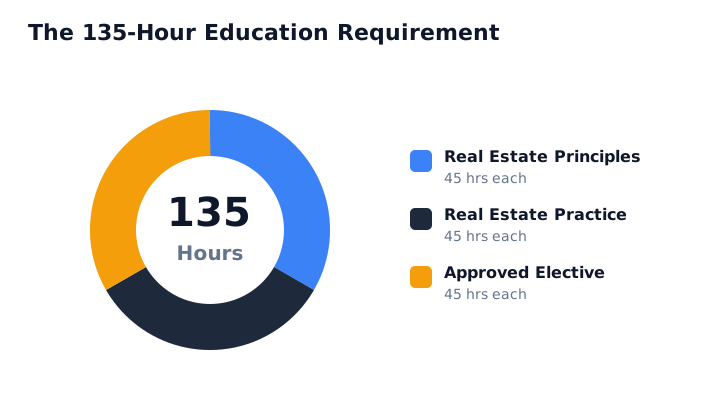
The 135-hour education requirement: three 45-hour courses
Required courses
- Real Estate Principles — the foundational course covering ownership, agency, contracts, financing, valuation, and California-specific law. This is where most exam vocabulary lives.
- Real Estate Practice — the day-to-day mechanics of the job: listings, prospecting, disclosures, escrow, and ethical practice.
Choose one elective
Pick one DRE-approved elective. Popular options include:
- Legal Aspects of Real Estate
- Real Estate Finance
- Real Estate Appraisal
- Property Management
- Escrows
Each course is typically 45 hours (3 courses × 45 = 135). Providers must impose a statutory minimum enrollment period per course, so you cannot legally rush all three in a weekend — plan for at least a few weeks even if you study intensively. Choose an elective that matches your interests: if you are eyeing commercial or investment work, Real Estate Finance pays off; if you like transactions, Escrows or Legal Aspects can reinforce exam content.
Reinforce your coursework with the NotJustExam California Real Estate Salesperson question bank — 223 interactive questions with AI explanations that cite California license law, aligned to the DRE content outline.
Practice Now — $9.99 →Steps to Get Your California Real Estate License
Here is the full journey from zero to a license in your hand. The sequence matters — some steps can overlap, but a few (like the background check) can bottleneck everything else if you leave them late.
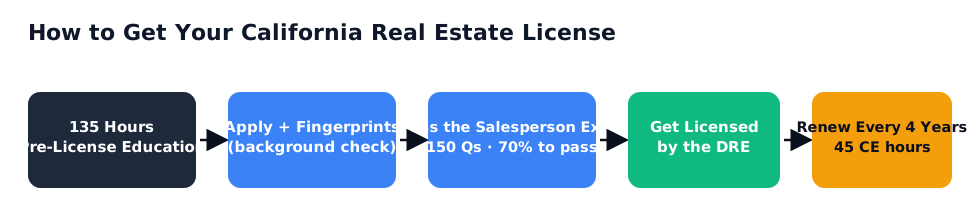
The step-by-step path from coursework to a licensed California salesperson
- Confirm eligibility — verify you are 18+ and review any background disclosures.
- Complete the 135-hour education through a DRE-approved provider and obtain your course completion certificates.
- Submit your exam application (or the combined exam/license application) to the DRE with fees and course proof.
- Get fingerprinted via live scan for the background check — do this early.
- Schedule your exam once your application is approved, choosing a test center.
- Pass the exam with 70% or higher.
- Receive your license once the exam is passed and the background check clears. If you used the combined application, the license follows automatically; otherwise you file a separate license application.
- Affiliate with a broker — a salesperson must work under a licensed broker to activate and use the license.
File the combined exam/license application and submit fingerprints at the same time. This overlaps the background check with your exam prep, so your license can issue almost immediately after you pass.
Exam Format & Content Areas
The California real estate salesperson exam is a computer-based test with the following structure:
| Attribute | Detail |
|---|---|
| Questions | 150 multiple-choice |
| Time limit | 3 hours 15 minutes |
| Passing score | 70% (105 correct) |
| Format | Electronic, at a DRE test center |
| Test centers | Sacramento, Oakland, La Palma (LA area), San Diego, Fresno |
| Guessing penalty | None — answer every question |
The DRE organizes the exam into seven content areas, each weighted differently. Knowing the weights tells you exactly where to spend your study hours. The single largest area — Practice of Real Estate and Disclosures — is a quarter of the whole exam, so it deserves a quarter of your attention.
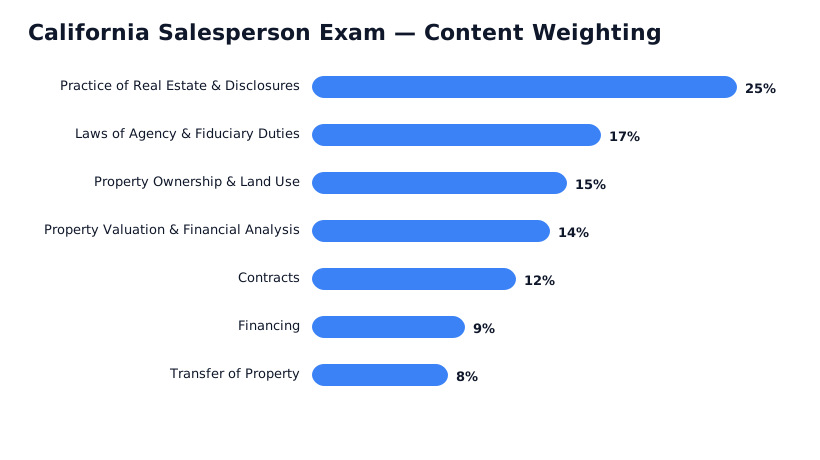
How the 150 questions are distributed across the seven DRE content areas
| Content Area | Approx. Weight | ~Questions |
|---|---|---|
| Practice of Real Estate & Disclosures (incl. specialty areas) | ~25% | ~38 |
| Laws of Agency & Fiduciary Duties | ~17% | ~25 |
| Property Ownership & Land Use Controls/Regulations | ~15% | ~23 |
| Property Valuation & Financial Analysis | ~14% | ~21 |
| Contracts | ~12% | ~18 |
| Financing | ~9% | ~14 |
| Transfer of Property | ~8% | ~12 |
Two areas — Practice/Disclosures and Agency — together make up roughly 42% of the exam. If you master those, plus the vocabulary in Property Ownership, you have covered well over half the test. Financing and Transfer of Property are the smallest slices, so do not over-invest there.
🎯 Rehearse Under Real Exam Conditions
Passing is a stamina game as much as a knowledge game. Practice with a full bank of California-aligned questions so exam day feels familiar:
- 223 interactive questions mapped to all seven DRE content areas
- AI explanations that cite the underlying California license law
- Printable PDF so you can study offline or on paper
- One-time $9.99 purchase — no subscription
How Hard Is the California Real Estate Exam?
Honestly? It is harder than most first-timers expect, but entirely beatable with structured prep. Reported (approximate) first-attempt pass rates hover around the 50% mark — these figures are not officially published pass rates, but they reflect widely-cited candidate outcomes. The people who fail usually share a few traits: they crammed vocabulary without practicing questions, they underestimated the wordy agency and disclosure scenarios, or they ran out of time.
What makes it challenging:
- Volume: 150 questions in 195 minutes means about 78 seconds per question — you cannot afford to freeze.
- Vocabulary density: terms like fiduciary duty, novation, escheat, and rescission appear constantly and are easy to confuse.
- Scenario framing: many questions describe a situation and ask what an agent should do, testing judgment rather than pure recall.
- A little math: commission splits, proration, loan-to-value, and area calculations show up — basic arithmetic, but you must be quick.
The single most effective countermeasure is repeated timed practice testing. Doing hundreds of realistic questions trains both your recall and your pacing, and it surfaces the specific topics where you are weak while you still have time to fix them.
A Proven 90-Day Study Plan
You can prepare in less time, but 90 days is a comfortable, low-stress runway for a working adult. Adjust the pace to your schedule — the structure matters more than the exact calendar.
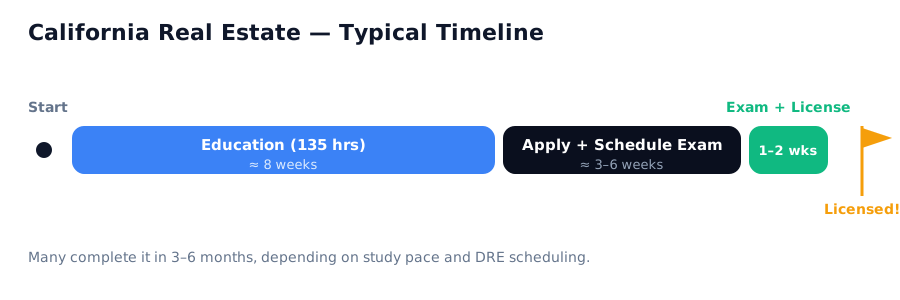
A 90-day timeline: build foundations, drill weak areas, then simulate exam day
Days 1–30: Build the foundation
- Work through your Real Estate Principles coursework and take notes on every new term.
- Create a running glossary — aim to add 10–15 vocabulary terms per study session.
- Start light practice questions by topic (not timed yet) to see how concepts are tested.
Days 31–60: Deep dive on the heavy-weight areas
- Concentrate on Practice of Real Estate & Disclosures and Laws of Agency — together ~42% of the exam.
- Drill Property Ownership and Valuation vocabulary and math.
- Begin topic-based quizzes and review every wrong answer until you understand why it was wrong.
Days 61–90: Simulate and refine
- Take full-length, 150-question timed practice exams to build stamina and pacing.
- Track your score trend — you want to be consistently at 80%+ on practice tests before booking the real exam (a comfortable buffer above the 70% pass line).
- Revisit your weakest content area for a final focused review the week before test day.
Use the NotJustExam California Real Estate bank for your daily drills — each explanation cites the relevant California license law, so you learn the reasoning, not just the answer key.
Practice Now — $9.99 →Costs & Fees (As of 2026)
Fees change, so treat these as 2026 estimates and verify the current amounts on the official DRE fee schedule at dre.ca.gov before you file.
| Item | Approx. Cost (2026) |
|---|---|
| Salesperson examination fee | ~$100 |
| Salesperson license fee | ~$350 |
| 135-hour pre-license education | ~$100–$500 (varies by provider) |
| Live-scan fingerprinting | ~$50–$80 (varies by location) |
| Practice question bank (NotJustExam) | $9.99 |
A combined exam/license application is available, which lets you pay the exam and license fees together and speeds up licensing after you pass. All told, expect roughly $600–$1,000 out the door depending on how much you spend on education. That is a modest investment relative to the earning potential of the license.
License term & renewal
A California salesperson license is valid for four years. To renew, salespersons must complete 45 hours of continuing education and pay the renewal fee. Mark your calendar — letting a license lapse creates extra hoops.
Career Outcomes & Income
The license is the entry ticket; your income is driven by effort, market, and specialty. Real estate is largely commission-based, so earnings vary widely — but California's high property values mean each transaction can generate substantial commission.
- New agents often spend their first 6–12 months building a pipeline; income can be modest during ramp-up.
- Established agents in active California markets frequently earn well into six figures, especially in high-price coastal metros.
- Specialties — luxury, commercial, property management, and investment sales — can raise your ceiling considerably.
- Path to broker: after gaining experience, many salespersons pursue the broker license to run their own office and earn a share of other agents' commissions. Note that the broker credential has higher education and experience requirements than the salesperson license covered here.
Because you work under a broker as a salesperson, choosing the right brokerage — one with good mentorship, leads, and a fair commission split — has a big impact on your first-year success. Interview a few before you commit.
Frequently Asked Questions
How hard is the California real estate exam?
It is challenging but passable. With 150 questions and a 70% pass bar, reported first-attempt pass rates sit around 50% — mostly because candidates under-practice. Structured study plus repeated timed practice tests dramatically improve your odds.
How many questions are on the exam and how long is it?
150 multiple-choice questions in 3 hours and 15 minutes. You need 105 correct (70%) to pass, and there is no penalty for guessing.
What education do I need before I can test?
Three college-level courses totaling 135 hours: Real Estate Principles, Real Estate Practice, and one DRE-approved elective (Legal Aspects, Finance, Appraisal, Property Management, Escrows, etc.).
How much does the whole process cost in 2026?
As of 2026, roughly $100 for the exam and $350 for the license, plus education (~$100–$500) and fingerprinting. Confirm current amounts on the official DRE fee page.
How long does it take to get licensed?
Typically 4 to 6 months, gated mostly by the 135-hour coursework and the background check. Aggressive full-time study can compress this to 3–4 months.
Where can I take the DRE exam?
At DRE test centers including Sacramento, Oakland, La Palma (Los Angeles area), San Diego, and Fresno.
Pass the California Real Estate Exam With Confidence
223 interactive, California-aligned practice questions with AI explanations and a printable PDF. One-time purchase. No subscription.
Get the CA Real Estate Bank — $9.99 →⭐ 4.7/5 · 58 reviews · Star Seller on Etsy