 NotJustExam
What Is an Enrolled Agent?
If you want to know how to become an enrolled agent, the short version is this: you pass a three-part IRS exam and clear a background check. The longer version — the fees, the format, the study plan, and what the credential actually does for your career — is what this guide walks you through, step by step, for 2026.
An enrolled agent (EA) is a federally licensed tax practitioner. According to irs.gov, the EA is the highest credential the IRS awards, and it grants unlimited rights to represent taxpayers before the IRS. That means an EA can handle audits, collections, and appeals for any client, on any tax matter, in any state — the same representation rights a CPA or attorney has, but earned through a tax-specific exam rather than an accounting degree or law license.
The exam that gets you there is the Special Enrollment Examination (SEE), a three-part test administered by Prometric on behalf of the IRS. Pass all three parts, clear a suitability check, and you carry a credential that is recognized in all 50 states without any state-by-state re-licensing.
Why Become an Enrolled Agent in 2026?
Tax complexity keeps rising, and so does demand for practitioners who can do more than fill in forms. Here is why the EA credential holds up well as a 2026 career move:
1. Unlimited representation rights. Unregistered and AFSP-only preparers face strict limits on who they can represent and when. An EA has no such ceiling — you can represent any client before any IRS office.
2. It is federal, so it travels. A CPA license is issued state by state. The EA is issued by the Treasury and is valid nationwide, which is ideal if you serve remote clients or plan to relocate.
3. Lower cost and faster than a CPA. There is no 150-credit-hour education requirement and no experience prerequisite to sit the SEE. Many candidates go from zero to enrolled in six to twelve months.
4. Recession-resistant demand. Taxes are filed every year regardless of the economy, and representation work often increases when budgets tighten and audits rise.
5. A clear path to independence. The EA is the natural credential for running your own tax and representation practice, and it pairs well with bookkeeping or financial-planning services.
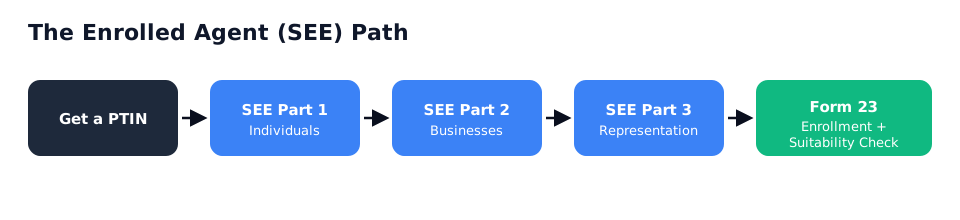
The enrolled agent credential path: PTIN → three SEE parts → Form 23 enrollment and suitability check
Requirements & the Path to Enrollment
There are no formal education or work-experience requirements to sit for the SEE. What you do need is a preparer identification number and a willingness to work through the process in order. Here is the full path, confirmed by the IRS "Become an Enrolled Agent" guidance:
Step 1: Obtain a PTIN
Before you can schedule the exam, you need a Preparer Tax Identification Number (PTIN) from the IRS. It is a quick online application and is required for anyone who prepares federal returns for compensation.
Step 2: Schedule and pay through Prometric
With a PTIN in hand, you create a Prometric account and schedule each part. You can take the three parts in any order and on separate days. Payment is made to Prometric at the time you schedule. You can verify the current fee on the Prometric IRS scheduling page.
Step 3: Pass all three SEE parts
You must pass Parts 1, 2, and 3 within a rolling three-year period. Each part you pass carries over for three years, so if you pass Part 1 in June 2026, you have until June 2029 to finish the other two before that credit expires.
Step 4: Apply for enrollment on Form 23
Once all three parts are passed, you file Form 23, Application for Enrollment to Practice Before the IRS, through Pay.gov. The enrollment fee is about $140 as of 2026.
Step 5: Pass the suitability check
The IRS runs a suitability review that includes a tax-compliance check (your own returns must be filed and any liabilities addressed) and a criminal background review. Once you clear it, you are an enrolled agent.
Step 6: Maintain the credential
EAs must complete 72 hours of continuing education per three-year cycle, including a required number of ethics hours, and renew enrollment on schedule to keep the credential active.
Get your PTIN first, then treat the three SEE parts as a project with a hard three-year deadline. The order is flexible — most candidates start with Part 1 (Individuals) because it overlaps with what they already know from preparing personal returns.
The SEE: Three Parts Explained
The Special Enrollment Examination is split into three parts, each covering a distinct area of federal tax practice. Understanding what each part tests helps you decide your study order and where to spend the most time.
Part 1 — Individuals
Covers individual taxpayers: filing requirements, income and assets, deductions and credits, taxation, advising the taxpayer, and specialized individual returns. If you already prepare 1040s, this part will feel the most familiar. It is a strong place to start and build momentum.
Part 2 — Businesses
Covers business entities and their tax treatment: sole proprietorships, partnerships, corporations, S corporations, and trusts, plus business income, deductions, credits, and specialized business returns. This is the broadest and most technical part — and the one most candidates find hardest.
Part 3 — Representation, Practices & Procedures
Covers how you act on a client's behalf before the IRS: practices and procedures, representation, specific areas and types of representation, and completing the filing process. Circular 230 ethics, powers of attorney, examinations, and appeals all live here.
Our SEE Part 1 (Individuals) bank has 210 original practice questions aligned to the IRS content outline, each with an explanation citing the relevant rule — so you learn the "why," not just the answer.
Practice Now — $9.99 →Exam Format, Scoring & Blueprint Weights
Every SEE part follows the same structure, which makes your exam-day routine predictable once you have sat one part.
| Attribute | Detail |
|---|---|
| Questions per part | 100 multiple-choice |
| Seat time per part | 3.5 hours |
| Scoring scale | 40–130 (scaled) |
| Passing score | 105 |
| Delivery | Prometric test center (computer-based) |
| Testing window | May 1 – end of February (closed March–April) |
| Credit carryover | Passed parts valid for 3 years (rolling) |
The testing window matters for planning. The SEE is available from May 1 through the end of February, then closes during March and April each year while the IRS updates the content to reflect the most recent tax law. If you are aiming to finish before that blackout, work backward from late February.
Scores are reported on a scaled range of 40 to 130, with 105 the passing mark. A scaled score is not a raw percentage — it accounts for slight differences in difficulty across exam versions — so focus on mastering the material rather than chasing an exact question count.
Official content-outline blueprint weights
The IRS publishes the domains and their approximate weights for each part. Use these to prioritize your study time toward the heaviest topics.
| Part | Domain | Approx. weight |
|---|---|---|
| Part 1 — Individuals | Preliminary Work & Taxpayer Data | ~16% |
| Income & Assets | ~20% | |
| Deductions & Credits | ~20% | |
| Taxation | ~18% | |
| Advising the Taxpayer | ~13% | |
| Specialized Returns for Individuals | ~13% | |
| Part 2 — Businesses | Business Entities & Considerations | domain |
| Business Tax Preparation | domain | |
| Specialized Returns & Taxpayers | domain | |
| Part 3 — Representation | Practices & Procedures | ~31% |
| Representation before the IRS | ~28% | |
| Specific Areas / Types of Representation | ~22% | |
| Completion of the Filing Process | ~19% |
Notice how Deductions & Credits and Income & Assets together make up about 40% of Part 1, and how Practices & Procedures plus Representation account for roughly 59% of Part 3. Weighting your practice toward those domains is one of the highest-leverage decisions you can make.
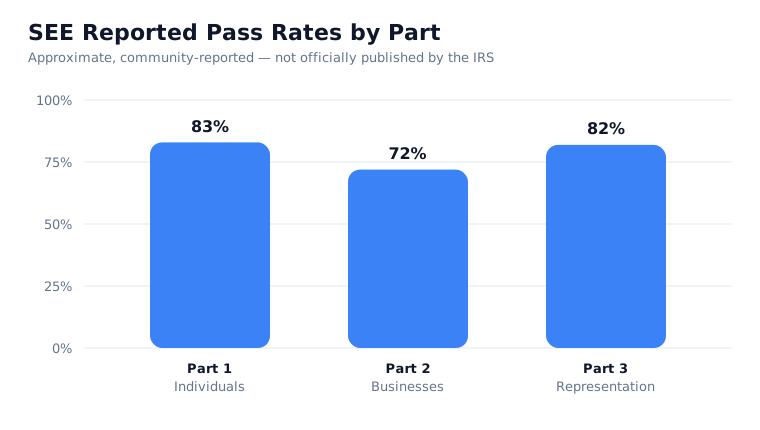
Reported (approximate) SEE pass rates by part — Part 2 is widely considered the toughest
Difficulty & Reported Pass Rates
The SEE is a serious professional exam, but it is very passable with focused study. Pass rates are reported and approximate — the IRS and Prometric do not officially publish them — so treat the figures below as community-reported guidance rather than official statistics.
- Part 1 (Individuals): reported ~80–85% pass rate. Familiar territory for anyone who preps personal returns.
- Part 2 (Businesses): reported ~70–75% pass rate — widely considered the hardest part because of the breadth of entity types and business tax rules.
- Part 3 (Representation): reported ~80–85% pass rate. Heavy on procedure and ethics, but conceptually cleaner than Part 2.
The practical implication: budget extra study time for Part 2. Many candidates pass Parts 1 and 3 on the first attempt and need a second run at Part 2. Building deep familiarity with partnership, corporate, and S-corp treatment ahead of time pays off.
Our SEE Part 2 (Businesses) bank has 224 original questions across entities, business tax prep, and specialized returns — the exact areas that trip up first-time test-takers.
Practice Now — $9.99 →Study Plan & Timeline
Most candidates complete all three parts in three to six months of steady study, though the rolling three-year window gives you plenty of slack if life gets busy. Here is a realistic, sequential plan.
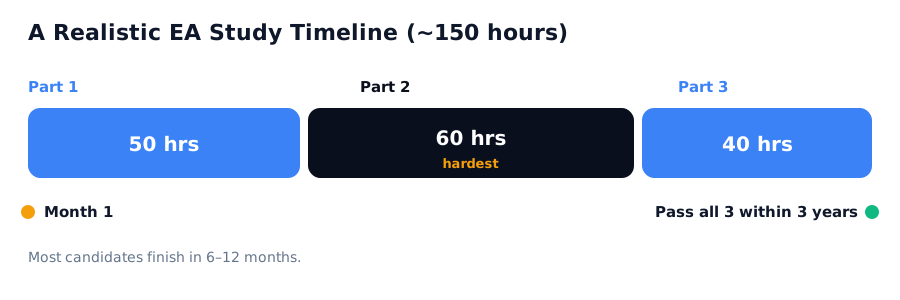
A sample enrolled agent study timeline — extra weeks are allocated to the harder Part 2
Weeks 1–6: Part 1 (Individuals)
- Work through a study guide chapter by chapter, mirroring the six Part 1 domains.
- Emphasize Income & Assets and Deductions & Credits (~40% combined).
- Drill a practice bank daily; review every wrong answer's explanation until the rule sticks.
- Sit a full timed practice set before scheduling the real thing.
Weeks 7–16: Part 2 (Businesses)
- Give this the most runway — it is the toughest part.
- Master entity taxation: sole prop, partnership, C-corp, S-corp, and trusts.
- Practice depreciation, basis, and business deduction scenarios repeatedly.
- Use spaced repetition so earlier topics do not fade while you learn new ones.
Weeks 17–22: Part 3 (Representation)
- Focus on Circular 230, powers of attorney, examinations, appeals, and collections.
- Learn the procedural timelines cold — Part 3 rewards knowing the process.
- Finish with a timed full-length practice run.
After passing: enrollment
- File Form 23 on Pay.gov and pay the ~$140 enrollment fee.
- Make sure your own tax filings are current before the suitability check.
- Plan your first CE cycle (72 hours over three years, ethics included).
🎯 Study the Full 3-Part SEE Set
Cover the entire Special Enrollment Examination with three focused NotJustExam practice banks — interactive and printable PDF, aligned to the IRS content outline, with explanations that cite the underlying rule:
- SEE Part 1 — Individuals (210 questions)
- SEE Part 2 — Businesses (224 questions)
- SEE Part 3 — Representation (239 questions)
Cost Breakdown (As of 2026)
The EA is one of the most affordable advanced credentials you can earn. Here is what to budget, with figures current as of 2026 — always verify the exam fee on the official Prometric page before you register, since fees change.
| Item | Cost (as of 2026) | Notes |
|---|---|---|
| SEE Part 1 fee | ~$267 | Paid to Prometric at scheduling |
| SEE Part 2 fee | ~$267 | Paid to Prometric at scheduling |
| SEE Part 3 fee | ~$267 | Paid to Prometric at scheduling |
| Enrollment (Form 23) | ~$140 | One-time, via Pay.gov after passing |
| PTIN | Low annual fee | Required before scheduling |
| Study materials | $30–$500+ | Practice banks from $9.99; full courses cost more |
| Typical all-in total | ~$950–$1,500 | Excludes any retakes |
Compared with the multi-thousand-dollar cost and 150-credit-hour education requirement behind a CPA license, the EA is a lean investment for a credential with the same IRS representation rights. Verify the current per-part fee on the Prometric IRS scheduling page.
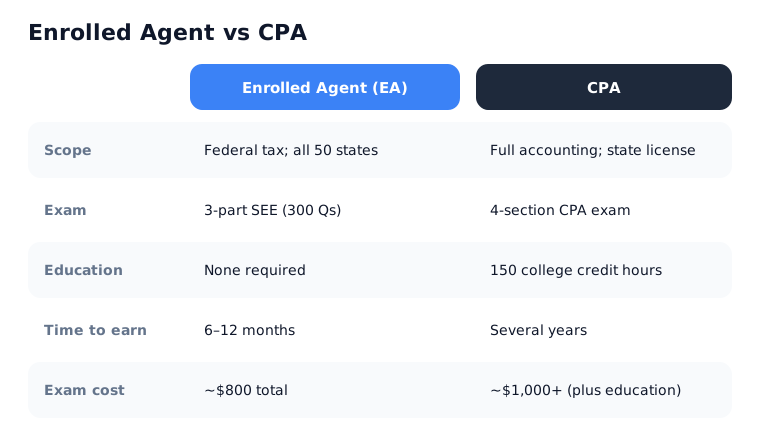
Enrolled agent vs CPA at a glance — federal tax focus versus broader, state-licensed accounting scope
EA vs CPA: Which Is Right for You?
The EA and CPA are often compared, but they solve different problems. For tax representation before the IRS, they are equivalent — both have unlimited rights. The differences show up in scope, jurisdiction, and how you earn them.
| Factor | Enrolled Agent (EA) | CPA |
|---|---|---|
| Issued by | U.S. Treasury / IRS (federal) | State board of accountancy |
| Jurisdiction | All 50 states | Per-state license |
| IRS representation rights | Unlimited | Unlimited |
| Focus | Federal taxation & representation | Broad accounting: audit, attest, tax, advisory |
| Education requirement | None | Typically 150 college credit hours |
| Exam | 3-part SEE | 4-section CPA Exam |
| Time to earn | Often 6–12 months | Often 18 months–several years |
Choose the EA if your career centers on tax preparation, planning, and representation; you want a nationwide credential without state-by-state licensing; or you want the fastest, lowest-cost route to unlimited IRS representation rights. Choose the CPA if you need audit and attestation authority or a broader accounting scope. Plenty of professionals hold both.
Career Outcomes & Salary
The EA opens doors across the tax profession. Because the credential is federal and tax-specific, it signals exactly one thing to employers and clients: you know federal tax and you can represent people before the IRS.
Where enrolled agents work
- Independent practice: Many EAs run their own tax-prep and representation firms, keeping the full fee for their work.
- Small and mid-size accounting firms: EAs handle preparation and represent clients in exams and collections.
- Tax resolution / representation firms: Specialized shops that negotiate with the IRS rely heavily on EAs.
- Corporate tax departments: In-house roles handling compliance and controversy.
- Seasonal to year-round: Filing season drives demand, but representation work runs all year.
Earning potential
Compensation varies widely by region, experience, and whether you are employed or self-employed. The credential's biggest financial lever is often independence: an EA running a practice can bill for representation work — audits, appeals, and collections — at rates well above simple return preparation. As you build a client base and a reputation, representation and advisory work compounds into a durable book of business.
Representation is where the EA credential earns its keep. Our SEE Part 3 (Representation) bank has 239 original questions on Circular 230, powers of attorney, examinations, and appeals.
Practice Now — $9.99 →Frequently Asked Questions
How long does it take to become an enrolled agent?
Most candidates finish in three to six months of focused study, then a few weeks for enrollment processing. The rolling three-year window to pass all three parts gives you flexibility if you need to spread it out.
Do I need a degree or accounting experience?
No. There is no education or experience requirement to sit for the SEE. You need a PTIN, and after passing you need to clear a tax-compliance and background suitability check.
Can I take the three parts in any order?
Yes. You can schedule the parts in any sequence and on separate days. Many candidates start with Part 1 (Individuals) because it is the most familiar.
What happens if I fail a part?
You can retake it. Just keep every passed part within the rolling three-year window so your earned credit does not expire before you finish all three.
How current do I need my own taxes to be?
Very. The suitability check includes a review of your personal tax compliance, so file any outstanding returns and address liabilities before you submit Form 23.
Your Path to the EA Credential Starts Now
Becoming an enrolled agent is one of the clearest, most attainable ways to build a serious tax career. There is no degree gate, the fees are modest, and the payoff is the highest credential the IRS awards — with unlimited representation rights that travel across all 50 states.
Your action plan:
- Apply for your PTIN.
- Schedule Part 1 (Individuals) and study 4–6 weeks.
- Give Part 2 (Businesses) extra runway — it is the hardest.
- Finish with Part 3 (Representation).
- File Form 23 on Pay.gov, clear the suitability check, and start earning.
The material is learnable, the path is well defined, and the credential compounds in value the longer you hold it. Take the first step today.
Pass the SEE with Confidence
Original, IRS-outline-aligned practice questions for all three SEE parts — interactive plus printable PDF, with rule-cited explanations. One-time purchase, no subscription.
Get the SEE Practice Banks — $9.99 each →⭐ 4.7/5 · 58 reviews · Star Seller on Etsy