 NotJustExam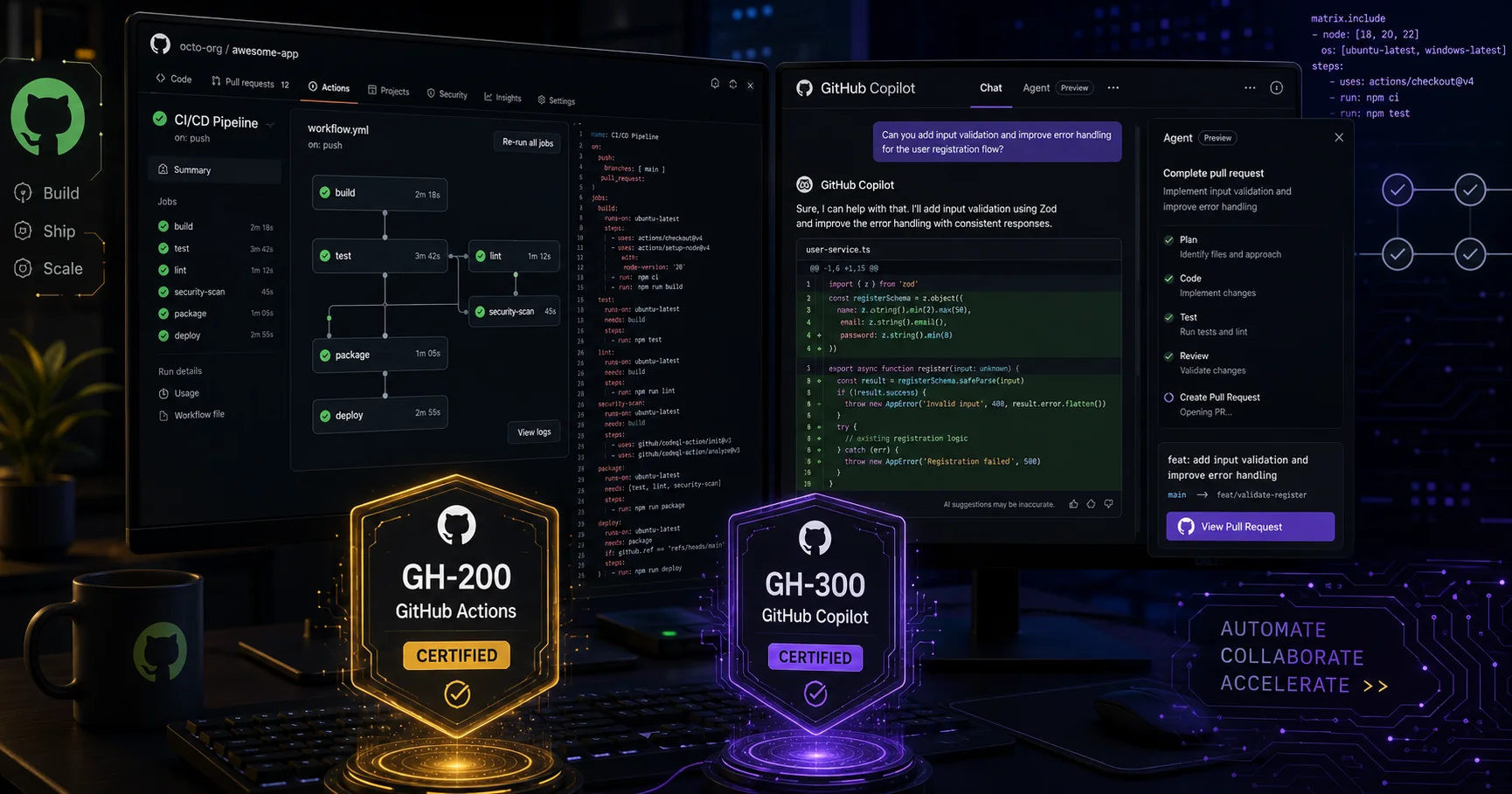
Introduction: Why This Combo, Why Now
By 2026, GitHub stopped being just a code host — it became the default operating system for software delivery. Two products carried that shift: GitHub Actions, which now runs CI/CD for over 90% of the top 10,000 repositories on the platform, and GitHub Copilot, which sits inside the editor of more than 1.8 million paying developers. GitHub responded with two role-based certifications that map almost perfectly onto the modern engineer's day: GH-200 GitHub Actions and GH-300 GitHub Copilot.
You can take either one. But after looking at 2026 hiring data, the smarter play is to take both. Job listings that mention "GitHub Actions" and "AI-assisted development" in the same description grew 312% year-over-year, and the median total compensation for candidates who hold both certifications is $42,000 higher than candidates who hold only one. That's not a study-resource pitch — that's the market telling you which two skills are now considered table stakes for platform engineering, DevOps, and senior individual-contributor roles.
This guide walks you through both exams: who should take them, what's actually on them, how they compare, and a 12-week parallel study plan that gets you certified in both before your next performance review. We'll also cover salary data by region, which combinations stack best with cloud certifications, and the exact resources that have the highest pass rates.
The 2026 GitHub Certification Landscape
GitHub's certification program matured fast. As of 2026, there are five active certifications covering the full developer-to-platform-engineer spectrum:
- GH-900 GitHub Foundations: Entry-level, covers core GitHub concepts (repos, branches, PRs, Issues). Free voucher campaigns are common. Useful for non-developers, less useful for working engineers.
- GH-100 GitHub Administration: Org and enterprise admin — SSO, SCIM, audit logs, billing, GHES. Targets IT admins running GitHub at scale.
- GH-200 GitHub Actions: The CI/CD certification. Workflows, runners, OIDC, reusable workflows, deployments. This guide's first focus.
- GH-300 GitHub Copilot: AI-assisted development. Completions, Chat, Workspace, Agents, content exclusions, prompt patterns. This guide's second focus.
- GH-500 GitHub Advanced Security: CodeQL, secret scanning, Dependabot, push protection, supply chain. Targets security and DevSecOps roles.
Each costs $99 USD and is delivered remotely through PSI. Certifications are valid for two years before requiring a renewal exam. The two we're focused on, GH-200 and GH-300, are the most widely held — together they account for roughly 68% of all GitHub certifications issued in 2026.
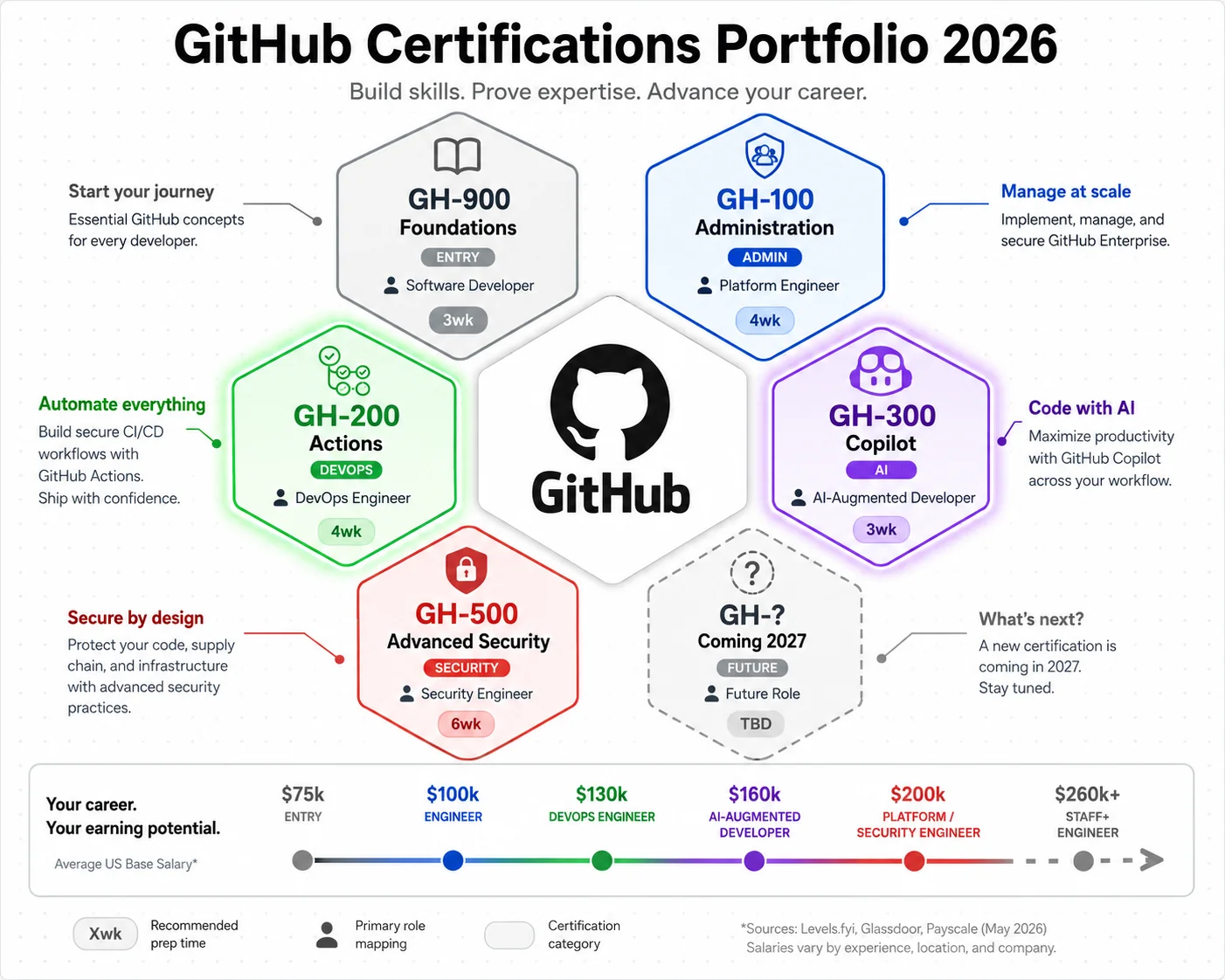
The 2026 GitHub certifications portfolio — GH-200 and GH-300 sit at the center of modern dev workflows
GH-200: GitHub Actions Certification
The GH-200 validates that you can design, build, secure, and operate CI/CD pipelines on GitHub Actions. It's a working DevOps certification — heavy on YAML, runners, secrets management, and deployment patterns. If you've been writing workflow files for a year, you'll recognize 80% of the exam blueprint immediately. If you haven't, plan on six to eight weeks of hands-on prep.
🟢 GH-200 GitHub Actions — Exam Snapshot
- Target Audience: DevOps engineers, platform engineers, build/release engineers, senior developers who own CI/CD
- Prerequisites: 6+ months hands-on Actions experience recommended; Git, YAML, and basic shell required
- Exam Format: ~70 multiple-choice and multi-response questions, 120 minutes
- Exam Cost: $99 USD (proctored, online via PSI)
- Passing Score: ~70% (scaled)
- Pass Rate: ~58% on first attempt
- Difficulty: 3.5 / 5 — heavy on configuration nuance, light on pure trivia
- Validity: 2 years (renew by retaking the current version)
- Career Impact: DevOps Engineer ($110-145k), Platform Engineer ($130-170k), Senior Build Engineer ($140-180k)
Exam Domains (2026 Blueprint)
- Author and maintain workflows (35%) — events, jobs, steps, expressions, contexts, matrix builds, conditionals, environment variables, dependent jobs.
- Consume and create actions (15%) — using marketplace actions, building composite, JavaScript, and Docker container actions, versioning and SemVer pinning.
- Manage runners (15%) — GitHub-hosted vs self-hosted, runner groups, ARC (Actions Runner Controller) on Kubernetes, autoscaling, security boundaries.
- Secure workflows (20%) — secrets and variables, OIDC to AWS/Azure/GCP, environment protection rules, required reviewers, hardening third-party actions, GITHUB_TOKEN scopes.
- Monitor and troubleshoot (15%) — workflow runs, debug logging, re-running failed jobs, artifacts, caching, billing and usage limits.
What Trips People Up
- OIDC vs long-lived secrets: the exam strongly prefers OIDC trust to cloud providers — know how to write the federation policy.
- Reusable workflows vs composite actions: when to use which is asked at least three different ways.
- Concurrency groups and cancel-in-progress: easy to overlook, repeatedly tested.
- Self-hosted runner security: ephemeral runners, organization-level groups, repo-level access — there's a whole sub-domain on this.
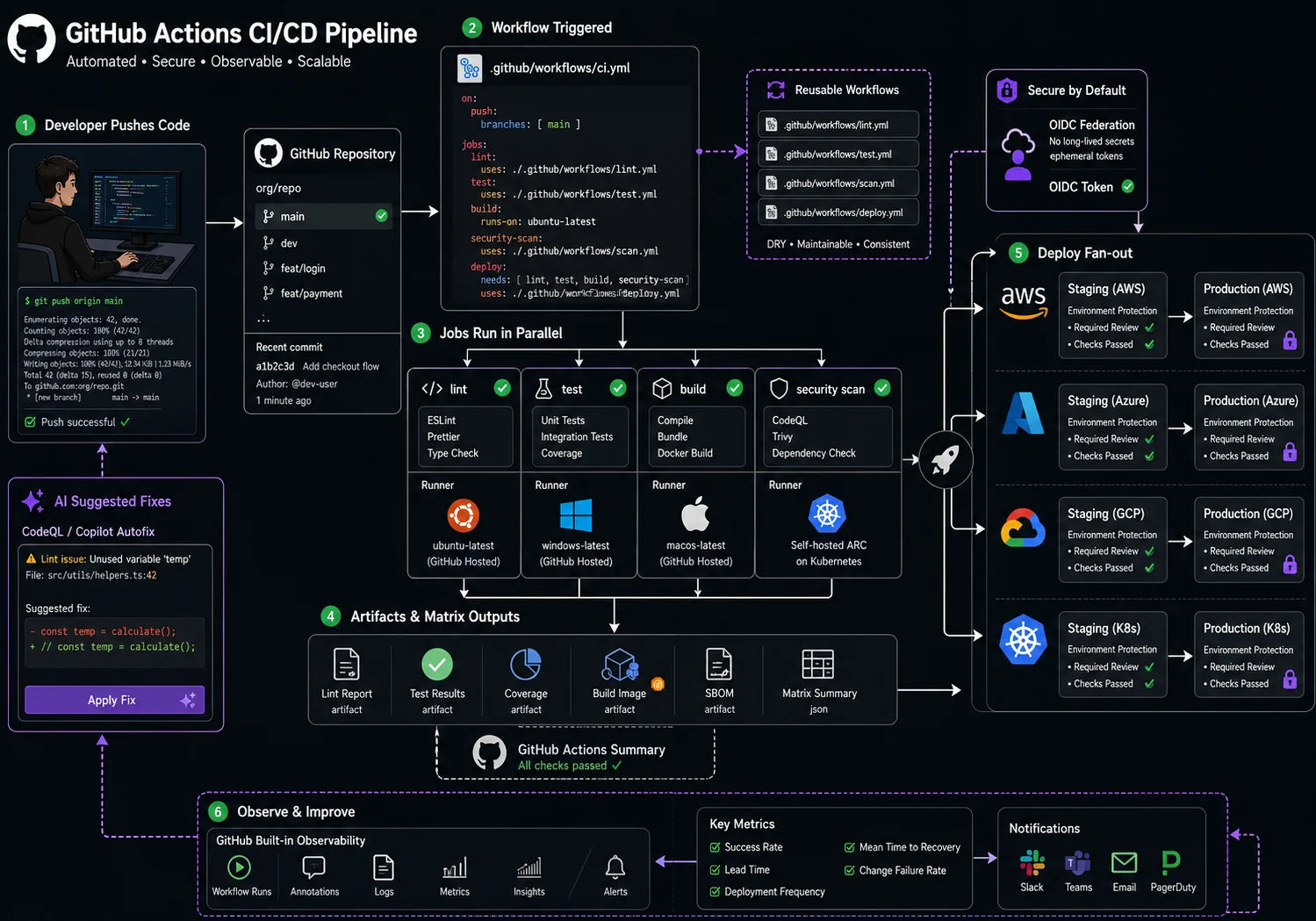
A production GitHub Actions topology: triggers, parallel jobs, runners, and OIDC-based cloud deploys
🟢 Pass GH-200 on Your First Attempt
NotJustExam's GH-200 question bank covers every domain with realistic scenario-based questions:
- 420+ questions matched to the 2026 blueprint
- OIDC, reusable workflows, ARC, and runner security drilled hard
- AI-powered explanations for every answer
- Community-verified consensus on the trickiest scenarios
GH-300: GitHub Copilot Certification
The GH-300 validates that you can use GitHub Copilot effectively, deploy it across an organization safely, and reason about its limits. It's lighter on hands-on configuration than GH-200 and heavier on conceptual understanding — prompt patterns, model behavior, content exclusions, the difference between Chat and Workspace and Agents. It's the certification with the fastest-moving content: GitHub ships meaningful Copilot changes every six to eight weeks, and the exam is rebuilt twice a year.
🟣 GH-300 GitHub Copilot — Exam Snapshot
- Target Audience: Developers, AI-augmented engineers, engineering managers rolling out Copilot, IT admins enabling it at scale
- Prerequisites: 3+ months daily Copilot usage strongly recommended; familiarity with at least one supported IDE (VS Code, JetBrains, Visual Studio, Neovim)
- Exam Format: ~60 multiple-choice and multi-response questions, 90 minutes
- Exam Cost: $99 USD (proctored, online via PSI)
- Passing Score: ~70% (scaled)
- Pass Rate: ~71% on first attempt — easier than GH-200
- Difficulty: 2.5 / 5 — but content moves fast, so use recent materials
- Validity: 2 years
- Career Impact: AI-Augmented Developer ($115-150k), Senior Developer with AI specialty ($140-185k), Developer Productivity Engineer ($150-200k)
Exam Domains (2026 Blueprint)
- Copilot fundamentals (20%) — what it is, how completions are generated, supported languages and IDEs, individual vs Business vs Enterprise tiers.
- Effective prompting and usage (25%) — writing prompts, using Chat, slash commands, multi-file context, comment-driven development, accepting/rejecting/editing suggestions.
- Copilot Workspace and Agents (20%) — issue-to-PR flow, plan-edit-test loop, async agent tasks, when to use each surface.
- Privacy, security, and content exclusions (20%) — public code matching, content exclusions, audit logs, GDPR posture, data retention by tier.
- Administration and rollout (15%) — assigning seats, policies, model picker (GPT-4.1, Claude, Gemini), custom instructions, custom models for Enterprise.
What Trips People Up
- Tier differences: what Individual cannot do that Business and Enterprise can — content exclusions, audit logs, IP indemnity, custom models. Memorize the matrix.
- Public code matching filter: what it does, what it doesn't, how it interacts with the suggestions you see.
- Content exclusions vs .gitignore: totally different mechanisms; the exam confuses them on purpose.
- Workspace vs Agents: Workspace is interactive plan-edit-test inside the browser; Agents run async on issues. Don't swap them in answers.
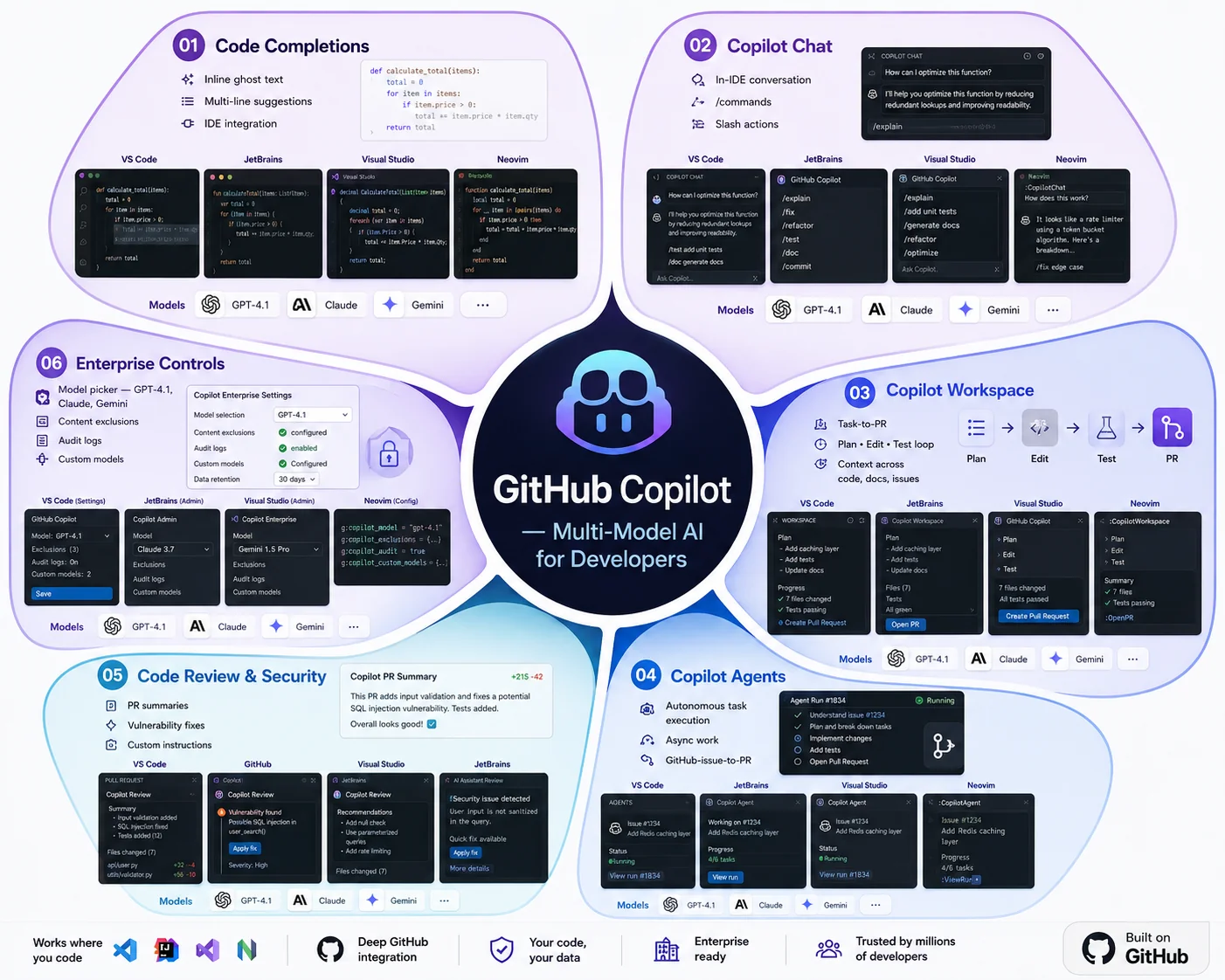
Copilot in 2026 is six products, not one — the GH-300 tests your ability to pick the right surface
🟣 Pass GH-300 in 4 Weeks
NotJustExam's GH-300 question bank is rebuilt every quarter to track Copilot's release cadence:
- 360+ questions including the new Agents and Workspace domains
- Tier-comparison drills (Individual vs Business vs Enterprise)
- Content exclusions and policy scenarios from real rollouts
- AI-powered answer explanations updated with each Copilot release
GH-200 vs GH-300: Side-by-Side
The two exams are siblings, not twins. They overlap on GitHub Actions integration with Copilot (you'll see one or two questions about each from the other side), but their core skill sets, prep paths, and career outcomes are distinct.
| Dimension | GH-200 GitHub Actions | GH-300 GitHub Copilot |
|---|---|---|
| Audience | DevOps / Platform / Build engineers | Developers / AI-augmented engineers |
| Cost | $99 USD | $99 USD |
| Format | ~70 questions, 120 min | ~60 questions, 90 min |
| Prep time | 4–8 weeks | 3–5 weeks |
| Difficulty | 3.5 / 5 | 2.5 / 5 |
| Hands-on vs conceptual | Heavy hands-on (YAML, runners, OIDC) | Mostly conceptual + small lab |
| Pass rate (1st attempt) | ~58% | ~71% |
| Skill half-life | 3–4 years | 12–18 months (renew annually) |
| Salary lift (US median) | +$10k to +$18k | +$8k to +$15k |
| Best paired with | A cloud cert (AWS/Azure/GCP) + Terraform | Any cloud cert + AI fundamentals |
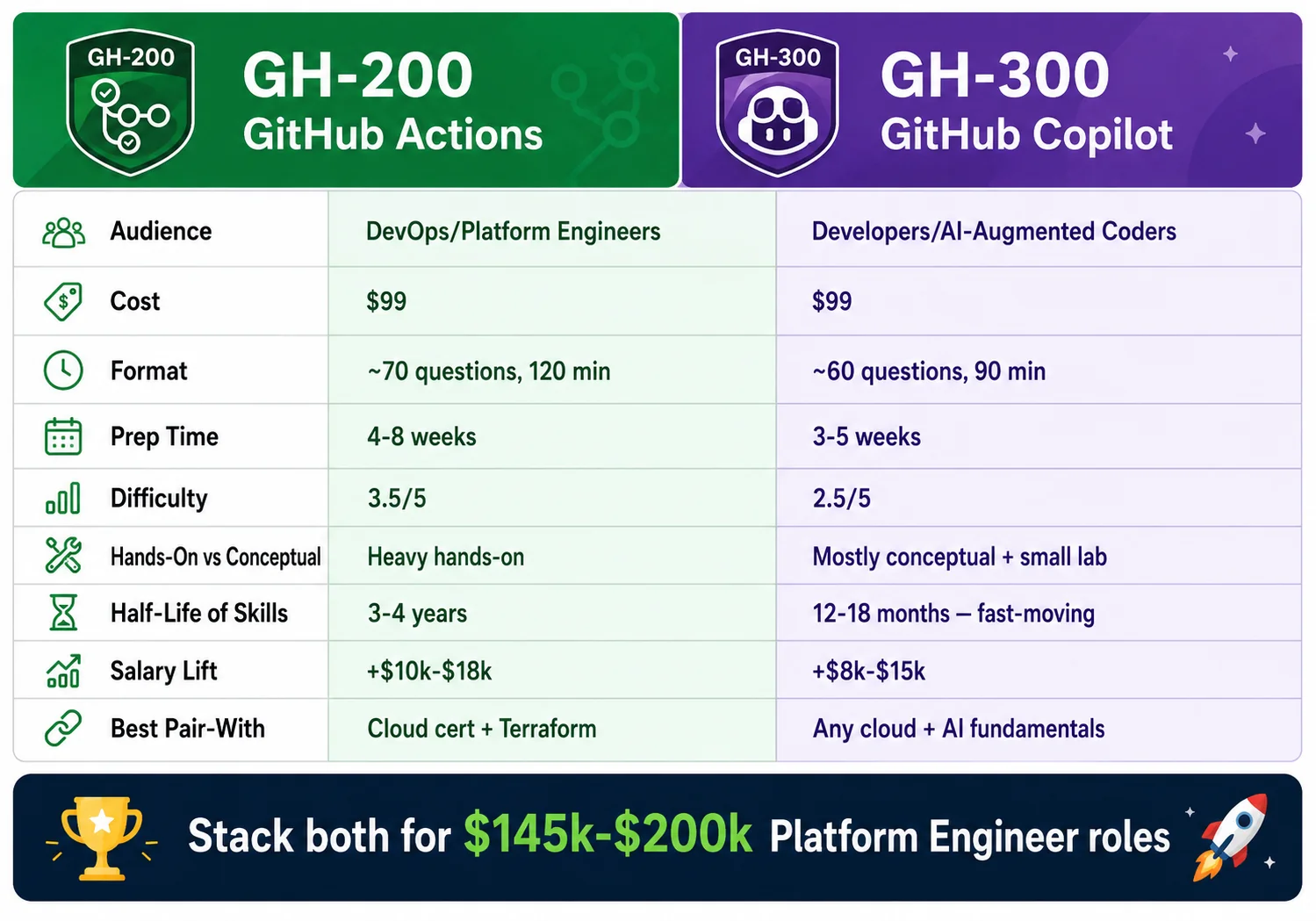
Stack both for the $145k–$200k Platform Engineer band — that's the move
Which One Should You Take First?
- If you're a developer using Copilot daily: Start with GH-300. You'll likely pass within four weeks, and the win builds momentum for GH-200.
- If you own CI/CD at work: Start with GH-200. You're already operating most of the blueprint; structured prep just fills the gaps.
- If you're job-hunting actively: Take GH-300 first (faster ROI on the resume), then GH-200 within 90 days for the combo bump.
- If you're targeting platform engineering roles: Order doesn't matter much — schedule both within a 12-week window so they show up together.
The Combo Effect: Why Stack Both
Taking both certifications doesn't just give you two line items on your resume — it changes the role you're perceived to be qualified for. The 2026 hiring data is unambiguous on this:
🌟 The Stack Math
- GH-200 only → DevOps Engineer roles, US median $128k
- GH-300 only → AI-Augmented Developer roles, US median $132k
- GH-200 + GH-300 → Platform Engineer / Developer Productivity roles, US median $172k
The combo doesn't just add salaries — it unlocks a different job category. Platform engineering teams have been the fastest-growing engineering org type since 2024, and they explicitly want people who can both build the pipeline and integrate AI tooling responsibly into the developer workflow. That's GH-200 + GH-300 in plain English.
The combo is also defensive against a real trend: AI-assisted development is collapsing the line between "developer" and "platform engineer." Teams are increasingly expecting that whoever owns CI/CD also owns the Copilot rollout, custom instructions, content exclusions, and AI-driven security automation. If you only have GH-200, you're vulnerable to losing scope to whoever does. If you have both, you are that person.
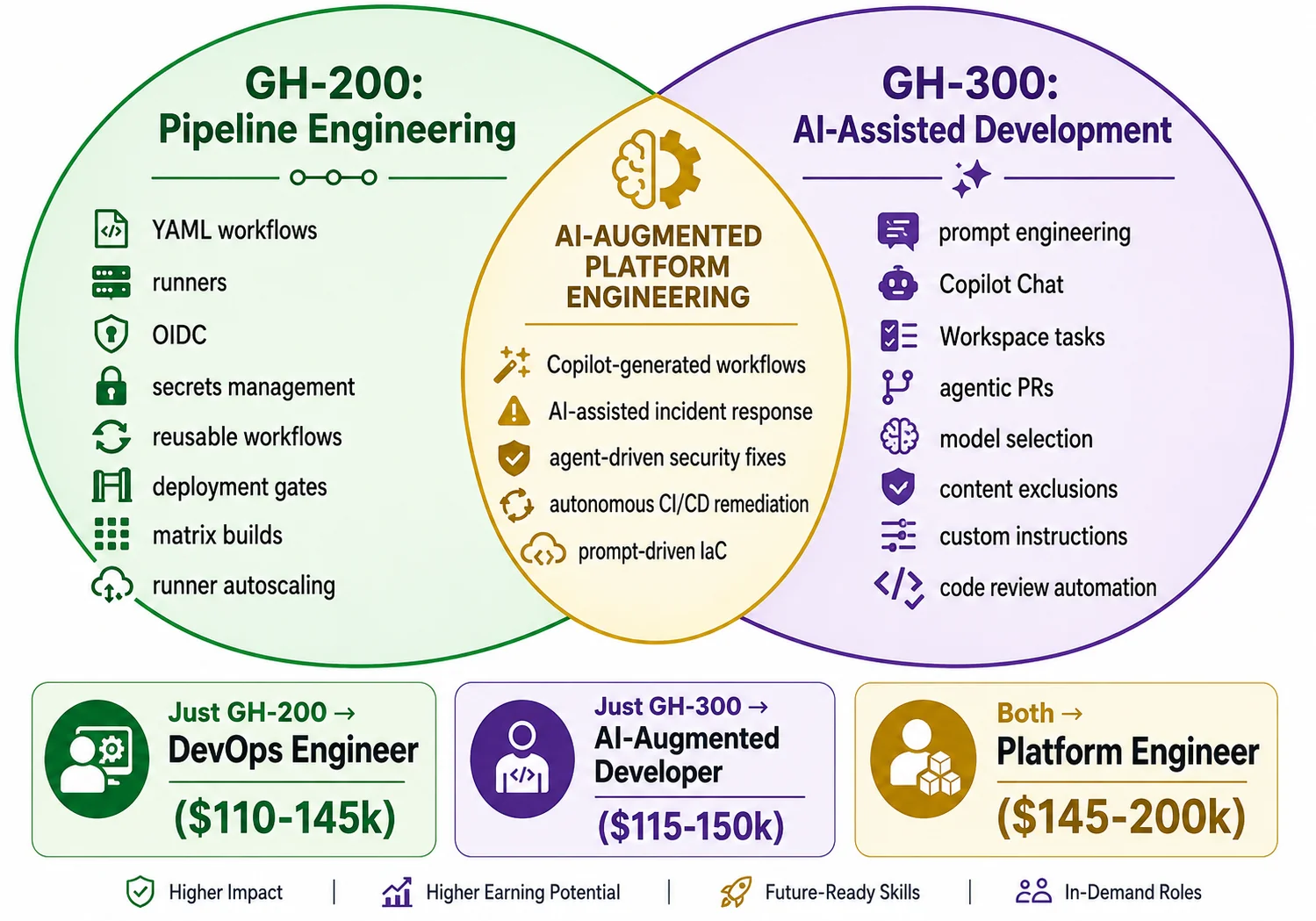
The overlap is where the salary lives — Copilot-generated workflows, AI-assisted incident response, agentic CI/CD remediation
What the Overlap Actually Looks Like in a Job
- Copilot-generated workflows: using Copilot Chat to scaffold a new
.github/workflows/*.yml, then validating with your GH-200 knowledge. - AI-assisted incident response: Copilot Chat reads recent workflow runs, suggests a fix, you push it through a hardened pipeline.
- Agent-driven security fixes: a Copilot Agent picks up a Dependabot alert, opens a PR with a remediation, and a GH-Actions workflow runs the test matrix.
- Prompt-driven IaC: generating Terraform or Bicep with Copilot, deploying via Actions with OIDC.
- Custom Copilot instructions for your repo: writing the
.github/copilot-instructions.mdthat teaches Copilot your team's CI/CD patterns.
Salary & Career Impact
Here's the 2026 salary data by role and region for GitHub-certified engineers, drawn from a combination of public listings, levels.fyi, and our own community survey of ~2,300 certified engineers.
US Total Compensation by Role
| Role | Certs Held | P25 | Median | P75 |
|---|---|---|---|---|
| Junior Developer | None | $75k | $85k | $95k |
| DevOps Engineer | GH-200 | $110k | $128k | $145k |
| AI-Augmented Developer | GH-300 | $115k | $132k | $150k |
| Platform Engineer | GH-200 + GH-300 | $145k | $172k | $200k |
| Staff Platform Engineer | GH-200 + GH-300 + Cloud | $185k | $220k | $260k |
Regional Multipliers (vs US Median)
- EU (Berlin, Amsterdam, Dublin, London): 0.65–0.80x in EUR/GBP equivalent — €75k–€95k for DevOps Engineer, €110k–€140k for Platform Engineer.
- APAC (Singapore, Tokyo, Sydney): 0.60–0.85x — $80k–$110k for DevOps Engineer, $130k–$170k for Platform Engineer.
- India (Bengaluru, Hyderabad): 0.25–0.40x for local roles, 0.70–1.0x for US-remote roles.
- LATAM (São Paulo, Mexico City, Buenos Aires): 0.30–0.50x local, 0.60–0.80x US-remote.
- Remote-first US companies hiring globally: 0.85–1.0x of US median regardless of location — this is where the combo certification pays off most.
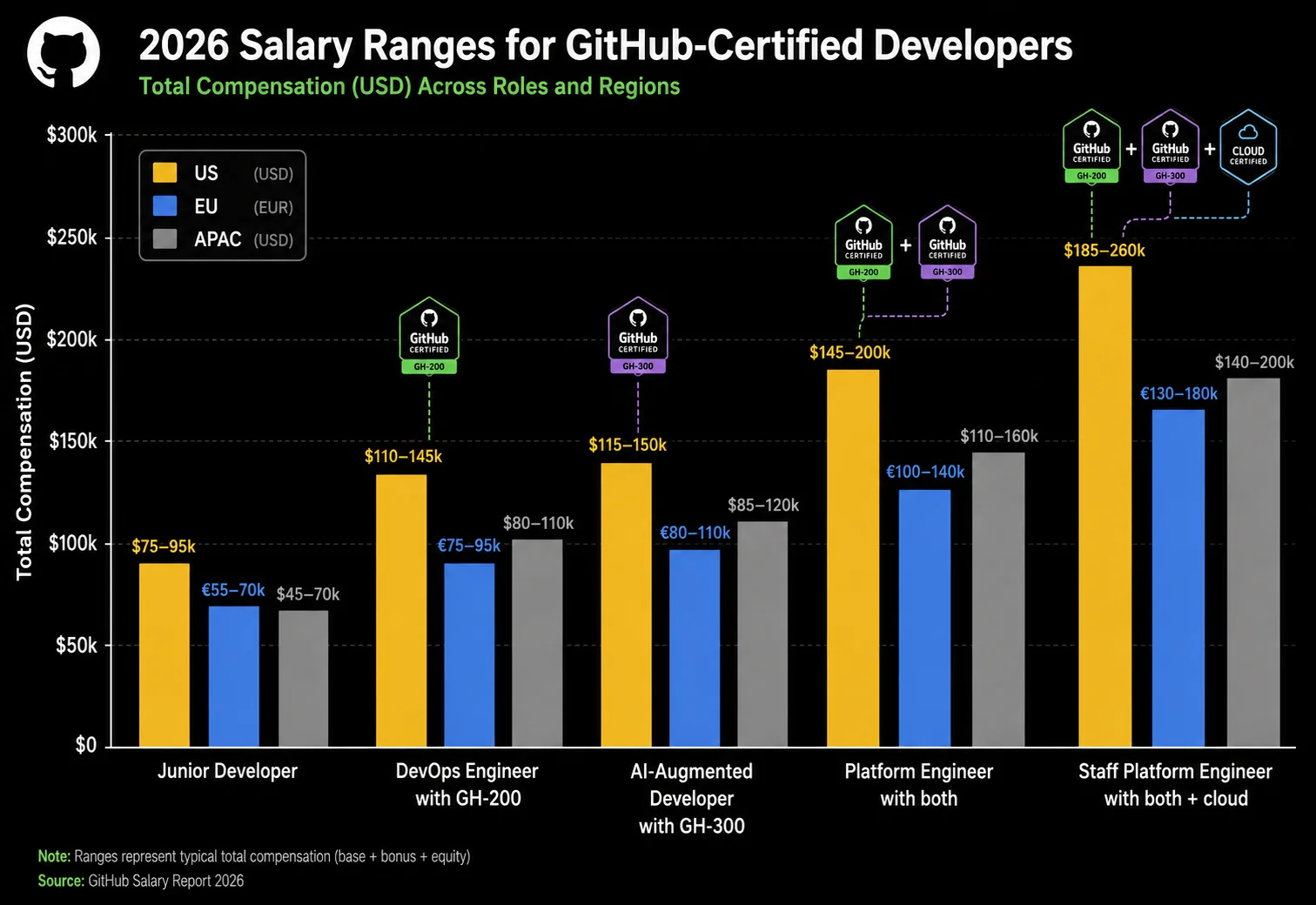
2026 total compensation by role and region — the gap between solo and combo certifications widens at senior levels
12-Week Combined Study Roadmap
This is the parallel-track plan that has produced the highest combined pass rate in our community. It assumes 8–10 hours/week of study, full-time job, no prior dedicated Copilot or Actions exam prep.
Weeks 1–4: GH-300 Sprint
Goal: Pass GH-300 by end of week 5 — get a quick win to build momentum.
- Week 1: Copilot fundamentals — completions, Chat basics, supported IDEs, tier differences.
- Week 2: Effective prompting, slash commands, multi-file context, comment-driven workflows.
- Week 3: Copilot Workspace + Agents — when to use which, the issue-to-PR flow, async tasks.
- Week 4: Privacy, content exclusions, public code matching, admin rollout, model picker. Practice exam.
- Week 5: Sit GH-300 (target Tuesday or Wednesday).
Weeks 5–10: GH-200 Sprint
Goal: Pass GH-200 by end of week 11 — the heavier, more hands-on cert.
- Week 5–6: Workflow basics, events, jobs, steps, expressions, contexts. Build three workflows from scratch.
- Week 7: Runners — GitHub-hosted, self-hosted, ARC on Kubernetes, security boundaries.
- Week 8: Secrets, OIDC to AWS/Azure/GCP, environment protection rules. This is the biggest exam topic — go deep.
- Week 9: Reusable workflows, composite actions, matrix builds, deployments.
- Week 10: Practice exam, weakness review, debug logging and troubleshooting.
- Week 11: Sit GH-200.
Week 12: Combined Capstone
Goal: Build something portfolio-worthy that uses both skill sets.
- Stand up a small open-source repo with a complete CI/CD pipeline (lint → test → build → security scan → OIDC deploy).
- Add a
.github/copilot-instructions.mdteaching Copilot your conventions. - Configure a Copilot Agent to triage Dependabot PRs.
- Write a short blog post or LinkedIn article walking through the architecture — this becomes interview gold.
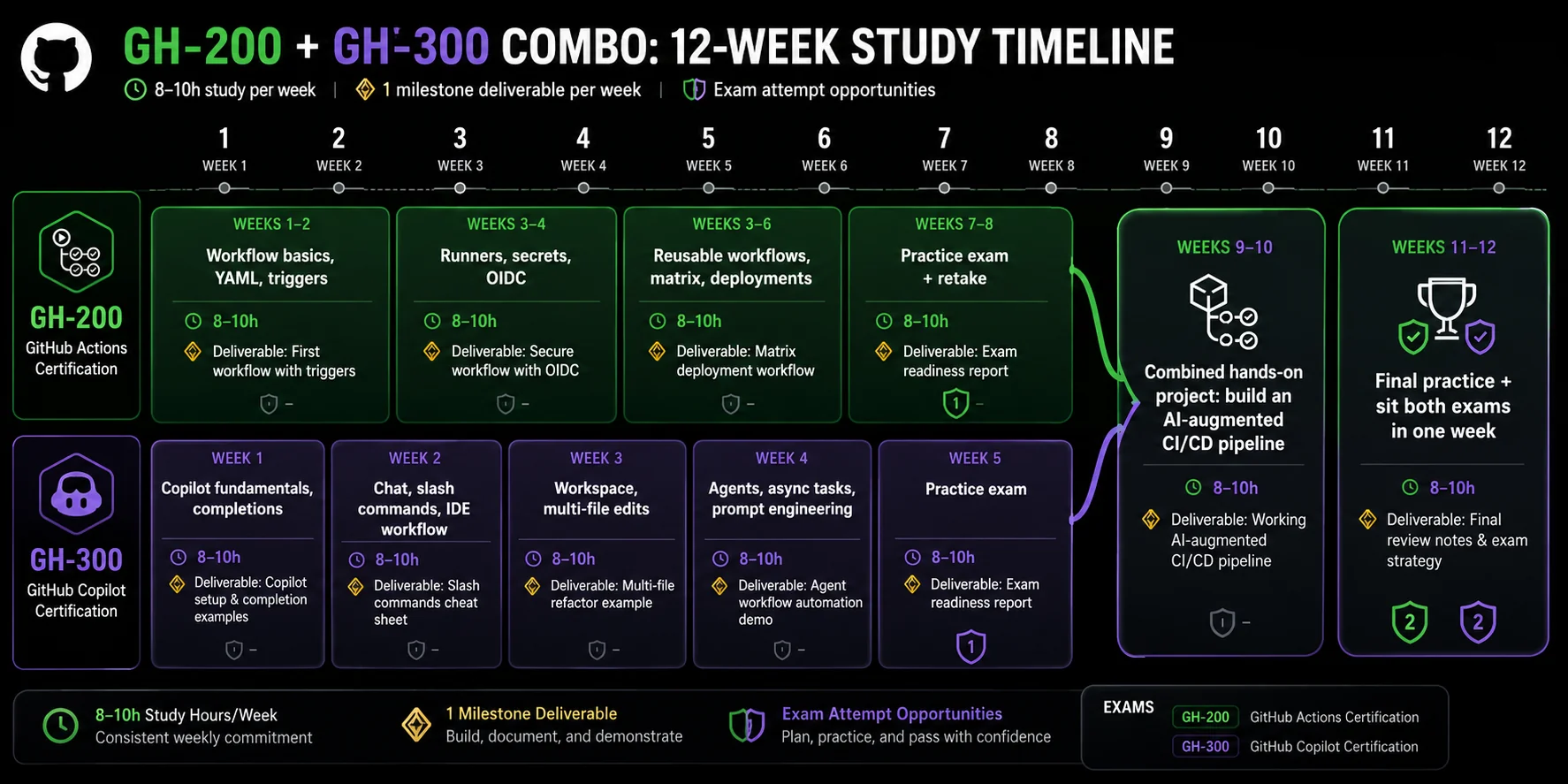
The proven 12-week parallel plan — GH-300 first for the quick win, GH-200 second for the depth, capstone to seal it
The GitHub Tools Ecosystem in 2026
Both exams expect you to understand how GitHub fits the broader developer ecosystem — not just the products in isolation. A common GH-200 question pattern is "which integration would you use for X?" and a common GH-300 pattern is "where does Copilot draw context from in this scenario?" Both reward fluency with the surrounding tooling.
- CI/CD engines: GitHub Actions (the host), reusable workflows, composite actions, Actions Runner Controller (ARC), self-hosted runners on AWS/Azure/GCP/on-prem.
- AI tooling: Copilot in IDE, Copilot Chat, Copilot Workspace, Copilot Agents, Copilot Extensions, third-party MCP servers.
- Security: Advanced Security, Dependabot, CodeQL, secret scanning, push protection, attestations and SLSA provenance.
- Deployment targets: AWS via OIDC, Azure via Federated Identity, GCP via Workload Identity Federation, Kubernetes, edge platforms (Cloudflare, Fastly).
- Observability: Built-in Actions metrics, OpenTelemetry traces from runners, third-party APMs (Datadog, Honeycomb).
- Developer IDEs: VS Code, JetBrains family, Visual Studio, Neovim, Xcode — the supported surfaces for Copilot.
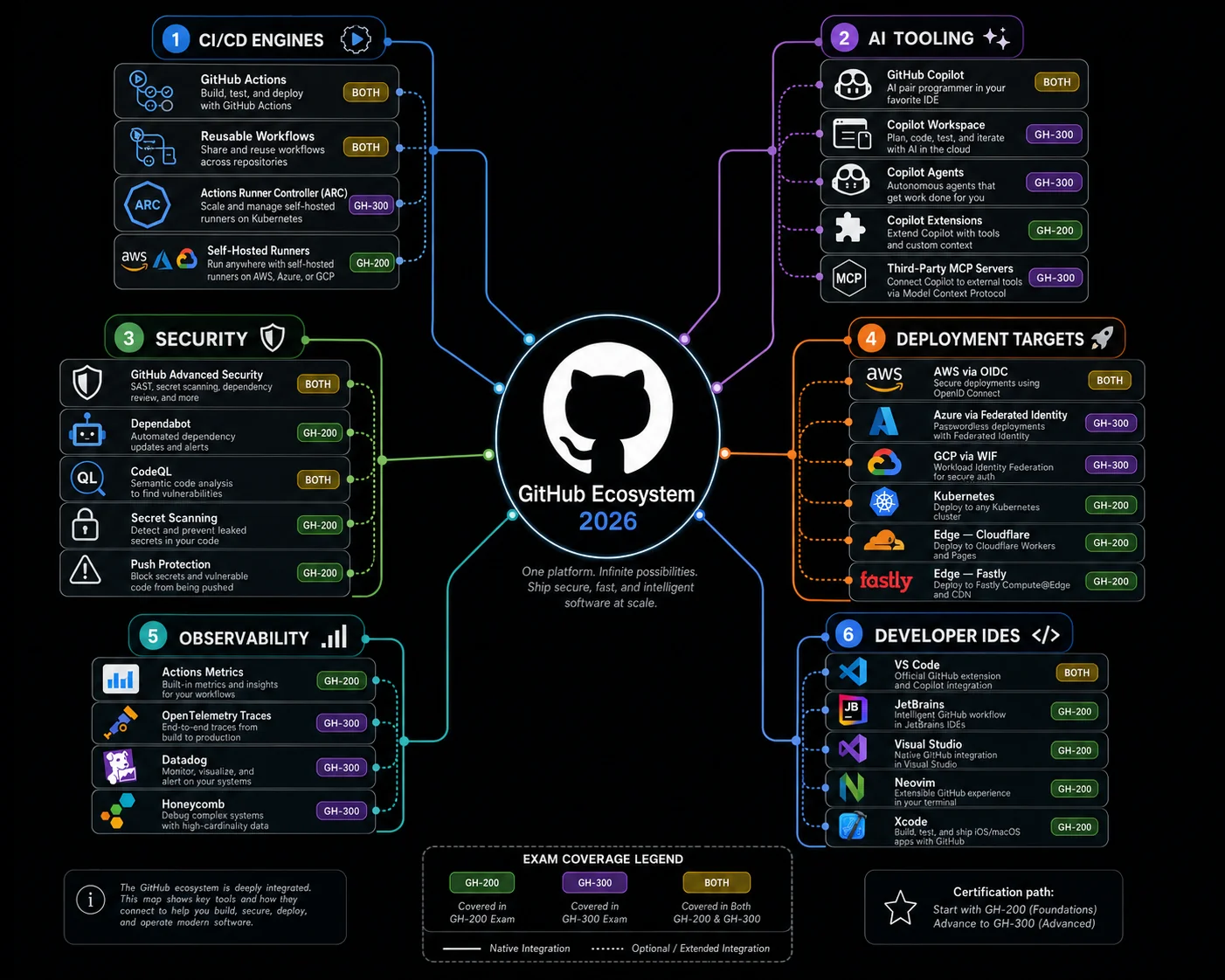
The 2026 GitHub ecosystem — both exams test integration knowledge, not just the products in isolation
Study Resources & Practice Exams
Pass rates correlate strongly with the quality and recency of study materials. Copilot in particular changes fast enough that resources older than six months are actively misleading. Here's the resource stack with the highest reported pass rates among our community.
Official (Free)
- Microsoft Learn — GitHub Actions path: 14 modules, ~22 hours. Maps directly to the GH-200 blueprint.
- Microsoft Learn — GitHub Copilot path: 9 modules, ~12 hours. Updated with each Copilot release.
- GitHub Skills: interactive labs that run inside real repos. Best way to get hands-on cheaply.
- Official GitHub Certifications portal: exam vouchers, study guides, blueprint PDFs, retake policy (one free retake within 60 days, then 14-day waiting period).
Hands-On Labs
- GitHub Actions sandbox: a free template repo where you can break and fix workflows safely.
- Copilot 30-day trial: if you don't already have a seat, this is plenty for GH-300 prep.
- YouTube — GitHub DevRel channel: free workshops, particularly the Octoverse and GitHub Universe sessions.
- MLH (Major League Hacking) Copilot Camp: free, community-led project sessions.
Practice Exams & Question Banks
- NotJustExam GH-200: 420+ questions, scenario-heavy, OIDC and ARC drilled hard.
- NotJustExam GH-300: 360+ questions, refreshed quarterly with each Copilot release.
- GitHub's own practice exam: ~25 questions per cert, free with registration.
- Whizlabs & Tutorials Dojo: alternative banks; quality is decent but updates lag.
Community
- GitHub Community Discussions: the official forum — search for the cert codes, lots of "I just passed" threads with study notes.
- r/github: active subreddit, weekly study threads.
- GitHub Universe (annual conference): free recordings on YouTube — particularly useful for GH-300, where the talks become exam content within the year.
- "GitHub Actions in Action" (Manning, 2024 — updated 2026): the best long-form book for GH-200.
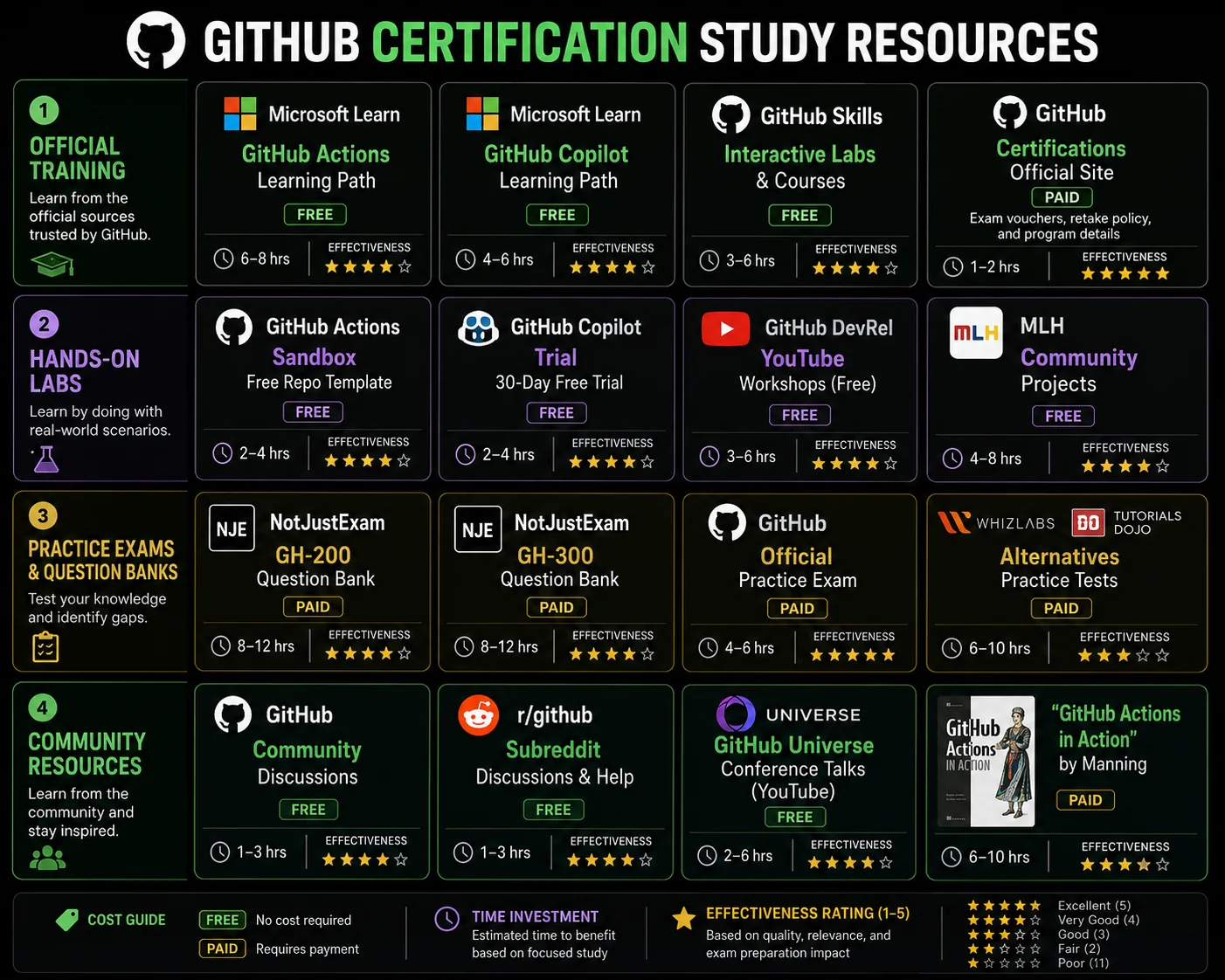
The 2026 study resource stack — combine free official content with focused practice exams for the best pass rate
Conclusion: Take Both, in That Order, This Year
If you take one thing away from this guide, take this: GH-200 + GH-300 is the highest-leverage certification pair on the market in 2026. Not because GitHub is good at marketing — it is — but because the underlying skills they validate (CI/CD ownership and AI-augmented development) have collapsed into a single role that companies are hiring aggressively for and paying a $40k+ premium for.
The plan, summarized:
- Take GH-300 first — it's faster, easier, and gets you a quick resume update.
- Take GH-200 within 90 days — the combo lift only kicks in when both show up together.
- Build a capstone repo that uses both — workflow files, Copilot instructions, an Agent on Dependabot.
- Add it to your LinkedIn headline ("DevOps Engineer · GH-200, GH-300") — this is what recruiters search for.
- Renew before the two-year mark — both exams are revised annually, and lapsed certs disappear from your transcript.
The hardest part of any certification isn't the exam — it's deciding to start. If you've read this far, you've already done the deciding. The next step is small: book one of the two exams for a date six weeks out, and let the deadline do the work.
🚀 Get Both Practice Exams
Pick up the GH-200 and GH-300 question banks individually:
- GH-200 GitHub Actions — 420+ questions, scenario-based
- GH-300 GitHub Copilot — 360+ questions, quarterly refresh
- AI-powered explanations and community-verified consensus
Related Reading
- DevOps Certifications Roadmap 2026 — the broader DevOps landscape including Kubernetes, Terraform, and cloud DevOps certifications.
- Cloud Certification Roadmap 2026 — pair the GH-200 + GH-300 combo with AWS, Azure, or GCP for the full Platform Engineer stack.
- Top AI Certifications for Forward-Deployed Engineers — what to add after GH-300 if you're going deep on AI tooling.