 NotJustExam
Introduction: A Brand-New Certification Program
In July 2026, Anthropic did something it had never done before: it put a name, a blueprint, and a proctored exam behind the skill of building with Claude. The Claude Certification Program is delivered through Pearson VUE (the same testing infrastructure behind AWS and CompTIA exams), issues a Credly digital badge on pass, and is anchored by two role-based Architect exams: CCAR-F (Claude Certified Architect – Foundations) and CCAR-P (Claude Certified Architect – Professional).
This isn't a vendor badge for knowing which button to click. Both exam guides are dense, scenario-driven, and explicitly test judgment — when to use a coordinator-subagent pattern versus a single agent, when RAG beats a bigger context window, when a governance control is proportionate versus overkill. If you've spent the last year building agents, wiring up MCP servers, or running Claude Code as a daily driver, these are the first exams built specifically to validate that experience.
This guide covers the two Architect exams in full — what's actually on each blueprint, what they cost, who they're really for, and a study plan that gets you through both. Anthropic's program also includes an Associate-Foundations tier and a Developer-Foundations tier; we're covering those in a separate guide once our practice material for them ships.
The Claude Certification Program: 4 Credentials
As of July 2026, the Claude Certification Program has four credentials across three roles — Practitioner, Architect, and Developer:
| Credential | Code | Status |
|---|---|---|
| Claude Certified Associate – Foundations | CCAO-F | Practice guide coming later |
| Claude Certified Architect – Foundations | CCAR-F | Covered in this guide |
| Claude Certified Architect – Professional | CCAR-P | Covered in this guide |
| Claude Certified Developer – Foundations | CCDV-F | Practice guide coming later |
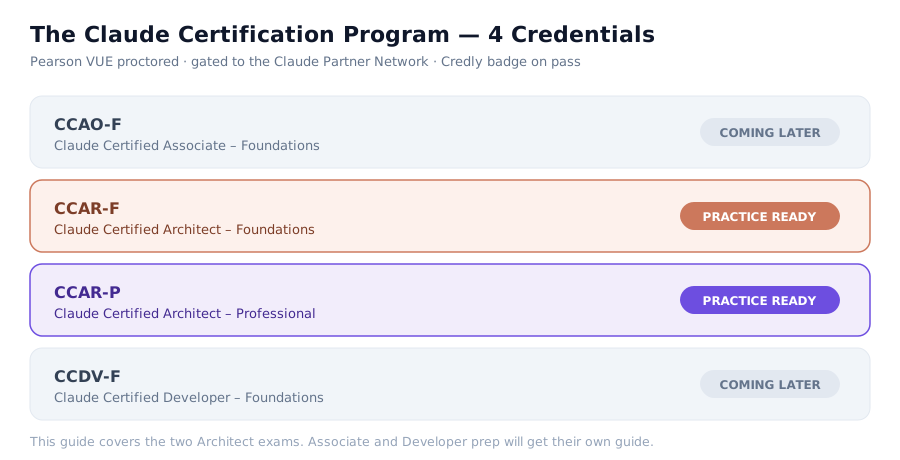
Two of four credentials, covered here — Associate and Developer prep get their own guide
Both Architect exams are delivered via Pearson OnVUE (test center or online proctored), scored on a scaled 100–1,000 range with a 720 cut score, valid for 12 months with a free renewal assessment if you renew on time, and cap retakes at 4 attempts per rolling 12 months with escalating 14/30/90-day waits after each fail. Neither requires the other as a prerequisite — CCAR-P does not require CCAR-F first.
CCAR-F: Claude Certified Architect – Foundations
CCAR-F is the entry point for architects who work primarily in Claude Code and agentic-tooling contexts. It's less about production API infrastructure and more about the day-to-day craft of designing agentic systems: how subagents coordinate, how tools get scoped and described, how a CLAUDE.md hierarchy and Skills actually govern behavior at the project level.
🟠 CCAR-F — Exam Snapshot
- Target Audience: Architects and engineers who build agentic systems and configure Claude Code at the team/project level
- Prerequisites: None formally required; hands-on experience with Claude Code, the Agent SDK, and MCP is assumed
- Exam Format: 60 scored multiple-choice/multiple-response questions across 4 of 6 possible scenarios, 120 minutes
- Exam Cost: $125 USD (Pearson VUE, test center or online proctored)
- Passing Score: Scaled 720 / 100–1,000
- Validity: 12 months, free renewal on time
- Result Reporting: Pass/fail + scaled score + per-domain percent-correct (informational, not used for pass/fail)
Exam Domains (Official Blueprint)
- Agentic Architecture & Orchestration (27%) — agentic loops and
stop_reason; coordinator-subagent patterns; the Task tool,AgentDefinition,fork_session; hooks vs. prompts for enforcement; session state and resumption. - Claude Code Configuration & Workflows (20%) —
CLAUDE.mdhierarchy and@import, custom slash commands and Skills, path-scoped rules, plan mode, CI/CD integration via--print/--output-format json. - Prompt Engineering & Structured Output (20%) — explicit-criteria prompting, few-shot for consistency, tool-use/JSON schema structured output, the Message Batches API, multi-pass review.
- Tool Design & MCP Integration (18%) — description-as-selection-mechanism tool design, structured MCP error responses, project- vs. user-scope
.mcp.json, tool distribution andtool_choice. - Context Management & Reliability (15%) — context preservation over long interactions, escalation-trigger design, structured error propagation across multi-agent systems, human-review calibration.
What Trips People Up
- Enforcement vs. suggestion: the exam consistently rewards a programmatic gate or hook over a prompt-only instruction when something destructive is on the line.
- Right-sized tool scoping: narrowly-scoped tools with clear descriptions beat broad, powerful ones the agent has to be told not to misuse.
- Escalation design: explicit criteria and few-shot examples beat "ask the model how confident it is" every time — self-reported confidence is a repeatedly-tested trap.
- The proportionate fix: across every official sample question, the correct answer is the smallest change that addresses the actual root cause — not the most sophisticated one.
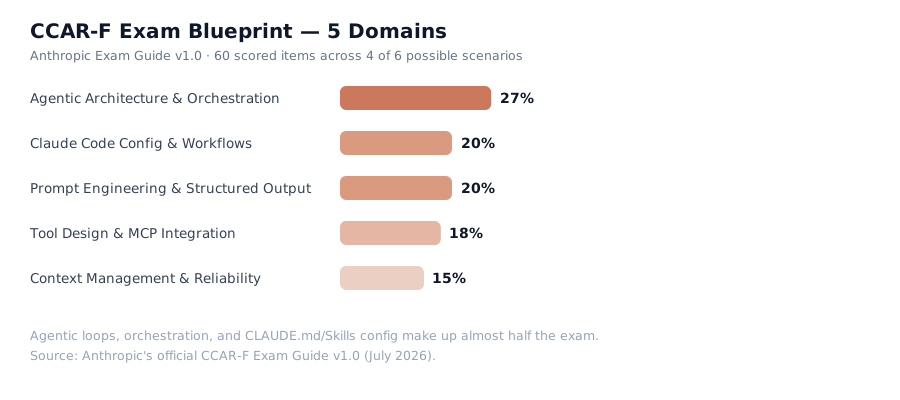
Agentic orchestration alone is over a quarter of the exam — heavier than any other single domain
🟠 Prep for CCAR-F the Right Way
NotJustExam's CCAR-F question bank is built from the official public blueprint — original scenario questions, not scraped or leaked content:
- 210+ AI-generated questions covering all 5 domains
- Agentic orchestration, MCP tool design, and Claude Code config drilled hard
- Step-by-step AI explanation + citations for every answer
- Interactive web app + printable PDF, instant download
CCAR-P: Claude Certified Architect – Professional
CCAR-P is the production-architecture credential — the exam for people who own how Claude gets deployed at scale, not just how it's configured in a single project. It leans hard into integration patterns (RAG pipelines, MCP vs. direct API vs. agent-to-agent), evaluation rigor, and the governance/compliance layer that shows up the moment an agentic system touches real customers or regulated data. Roughly a quarter of the items are multiple-response, which the guide itself flags as the biggest scoring risk.
🟣 CCAR-P — Exam Snapshot
- Target Audience: Solution architects and platform engineers who design and operate production Claude/LLM systems
- Prerequisites: None required; Anthropic recommends 3+ years of architecture/platform-engineering experience plus 6+ months hands-on with Claude/LLMs in production. CCAR-F is not a prerequisite.
- Exam Format: 63 scored questions — single-answer plus ~25% multiple-response ("Select TWO/THREE"), 120 minutes
- Exam Cost: $175 USD (Pearson VUE, test center or online proctored)
- Passing Score: Scaled 720 / 100–1,000
- Validity: 12 months, free renewal on time
Exam Domains (Official Blueprint)
- Integration (19%, heaviest domain) — MCP vs. direct API vs. agent-to-agent selection, tool-scoping and capability bloat, RAG pipeline design, auth/authz gaps, cross-request observability.
- Solution Design & Architecture (17%) — matching business problems to workflow/agentic/augmented-LLM patterns, multi-agent decomposition, tying design to cost/SLA/efficiency.
- Evaluation, Testing & Optimization (16%) — accuracy/latency/cost/safety metrics, eval dataset design, A/B testing, diagnosing prompt-failure vs. hallucination vs. model-mismatch.
- Governance, Safety & Risk Management (14%) — guardrail layering, human-in-the-loop placement, failure modes (hallucination, injection, overreliance), GDPR/HIPAA/FedRAMP scenarios.
- Stakeholder Communication & Lifecycle Management (14%) — structured discovery, setting probabilistic-accuracy expectations, documentation/handoff, post-launch feedback loops.
- Claude Models, Prompting & Context Engineering (13%) — model-tier selection by cost/latency, prompt caching, modular prompts, Claude Skills.
- Developer Productivity & Operational Enablement (7%) — team-level Claude Code configuration in version control, standardizing AI-assisted dev practices.
What Trips People Up
- Least-privilege by default: the correct fix for an over-permissioned agent tool is almost always to remove the capability, not add logging or a confirmation step.
- Multiple-response scoring: evaluate each option independently — don't pattern-match a "pair that feels related."
- One dominant constraint per scenario: a latency SLA, a compliance regime, or a fixed budget usually eliminates half the options once you spot it.
- The proportionate architecture wins: the simplest adequate design, cheapest adequate model, and lightest sufficient control set consistently beat the more elaborate-sounding option.
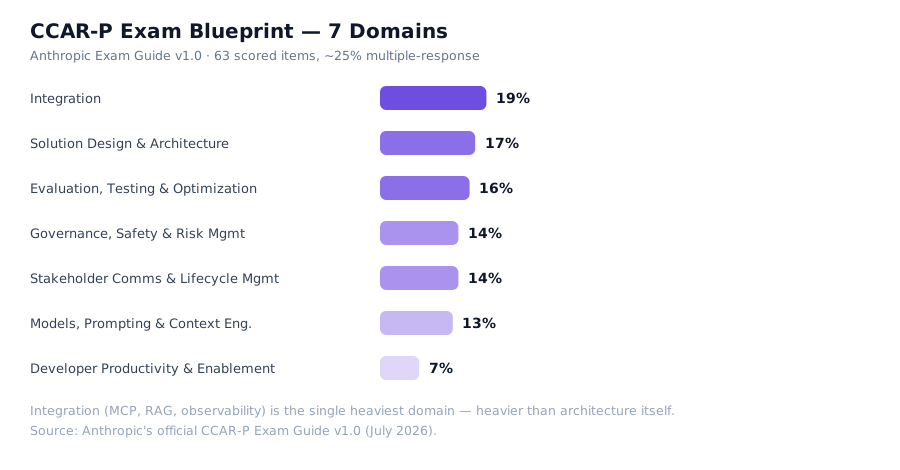
Integration outweighs pure solution design — CCAR-P tests how systems connect, not just how they're drawn on a whiteboard
🟣 Prep for CCAR-P the Right Way
NotJustExam's CCAR-P question bank covers all 7 domains, including the heavier multiple-response format:
- 210+ AI-generated scenario questions matched to the 2026 blueprint
- Integration, RAG design, and governance/risk scenarios drilled hard
- Multiple-response practice so "Select TWO/THREE" stops being a scoring risk
- Step-by-step AI explanation + citations for every answer
CCAR-F vs CCAR-P: Side-by-Side
Both exams are "Architect" credentials, but they sit at different altitudes: CCAR-F is about configuring and orchestrating agentic systems well; CCAR-P is about architecting, governing, and operating them in production at organizational scale.
| Dimension | CCAR-F Foundations | CCAR-P Professional |
|---|---|---|
| Focus | Agentic orchestration, Claude Code, tools/MCP | Production architecture, integration, governance |
| Cost | $125 USD | $175 USD |
| Format | 60 questions, 120 min | 63 questions (~25% multi-response), 120 min |
| Domains | 5 | 7 |
| Heaviest domain | Agentic Architecture & Orchestration (27%) | Integration (19%) |
| Prerequisite for the other | Not required for CCAR-P | Not required for CCAR-F |
| Validity | 12 months | 12 months |
| Best paired with | Daily Claude Code / Agent SDK usage | Production LLM deployment ownership |
Who Can Actually Sit These Exams
One thing every candidate should know before booking: the Claude Certification Program is currently gated to the Claude Partner Network. You can't just create an account and register the way you would for an AWS or CompTIA exam — your organization generally needs partner status with Anthropic, and community reports describe needing to get a cohort of people trained before individual registration opens up. If your employer isn't a partner, the practical path is usually: check with your Anthropic account team, or watch for the program to open more broadly as it matures.
This doesn't make the material any less worth learning. Agentic architecture, tool/MCP design, and production LLM governance are the actual skills the exams test for — skills that matter on the job whether or not you can book a seat this quarter. Studying the blueprint now means you're ready the moment access opens, and the same knowledge shows up directly in how well you design agents and integrations at work today.
10-Week Combined Study Roadmap
This is the parallel-track plan we'd recommend for someone who already uses Claude Code daily but hasn't studied either blueprint formally. It assumes 6–8 hours/week alongside a full-time job.
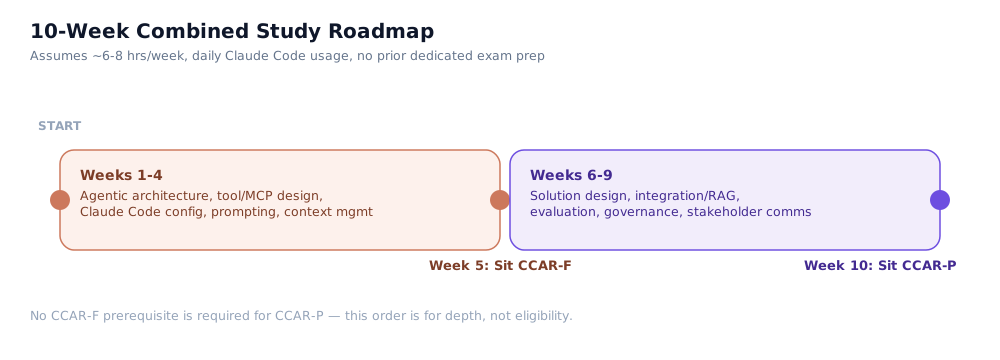
CCAR-F first for the faster, narrower blueprint; CCAR-P second once the production/governance layer is fresh
Weeks 1–5: CCAR-F
- Week 1: Agentic loops,
stop_reason, coordinator-subagent patterns, Task tool basics. - Week 2: Tool design, MCP integration,
.mcp.jsonscoping, structured error responses. - Week 3: Claude Code configuration —
CLAUDE.mdhierarchy, Skills, slash commands, path-scoped rules, CI/CD via--print. - Week 4: Prompt engineering, structured output, context management, escalation design. Practice exam.
- Week 5: Sit CCAR-F.
Weeks 6–10: CCAR-P
- Week 6: Solution design patterns — workflow vs. agentic vs. augmented-LLM, multi-agent decomposition.
- Week 7: Integration — MCP vs. direct API vs. agent-to-agent, RAG pipeline design, observability. The heaviest domain — go deep.
- Week 8: Evaluation and optimization — eval design, A/B testing, diagnosing failure classes.
- Week 9: Governance/safety/risk and stakeholder communication. Practice exam with multiple-response drills.
- Week 10: Sit CCAR-P.
Study Resources & Practice Exams
Official (Free)
- Anthropic's official Exam Guides: both CCAR-F and CCAR-P guides are freely downloadable PDFs with the full blueprint, task statements, and official sample questions — read these first.
- Anthropic Academy (Skilljar): hosts the partner-facing course content tied to the certification program.
- Claude Code & Agent SDK documentation: the primary source for hooks, subagents, MCP configuration, and Skills — most CCAR-F content maps directly onto it.
Hands-On
- Daily Claude Code usage: there's no substitute for actually configuring
CLAUDE.md, writing Skills, and building multi-agent workflows on a real repo. - Build a small MCP server: the fastest way to internalize tool-description-as-selection-mechanism and structured error responses.
- r/ClaudeAI and r/ClaudeCoding: active threads specifically about CCAR-F/CCAR-P prep and results.
Practice Exams
- NotJustExam CCAR-F: 210+ original scenario questions across all 5 domains, AI-explained.
- NotJustExam CCAR-P: 210+ original scenario questions across all 7 domains, AI-explained.
- Anthropic's own sample questions: 12 per exam guide, officially cleared for public study use — the best "what good looks like" reference before you buy anything.
Conclusion: A New Category, Worth Getting In Early On
CCAR-F and CCAR-P are the first exams that put a real bar on "can you architect agentic systems responsibly" — and getting familiar with both blueprints now, even while access is still gated to the Partner Network, puts you ahead of a category that's clearly going to keep growing. The material itself — agentic orchestration, MCP tool design, RAG integration, governance and evaluation — is exactly what teams already need from whoever owns their Claude deployments.
The plan, summarized:
- Start with CCAR-F if your day-to-day is Claude Code and agentic tooling; start with CCAR-P if you own production LLM architecture.
- Neither requires the other — take whichever matches your role first.
- Read Anthropic's official Exam Guide PDFs cover to cover before anything else; they're free and unusually detailed.
- Drill the multiple-response format specifically for CCAR-P — it's the single biggest scoring risk candidates report.
- If your organization isn't in the Claude Partner Network yet, study anyway — the skills transfer directly to your day job today.
🚀 Get Both Practice Exams
Pick up the CCAR-F and CCAR-P question banks individually:
- CCAR-F Architect Foundations — 210+ questions, all 5 domains
- CCAR-P Architect Professional — 210+ questions, all 7 domains
- AI-powered explanations with citations for every answer
Related Reading
- Top AI Certifications for Forward-Deployed Engineers — how CCAR-F/CCAR-P fit into the broader AI-certification landscape.
- GitHub Actions + Copilot Certifications 2026 — the other major AI-augmented-engineering certification combo.
- Complete Guide to Machine Learning Certifications — for the model/ML side of the AI stack.